
How to choose a Native American flute
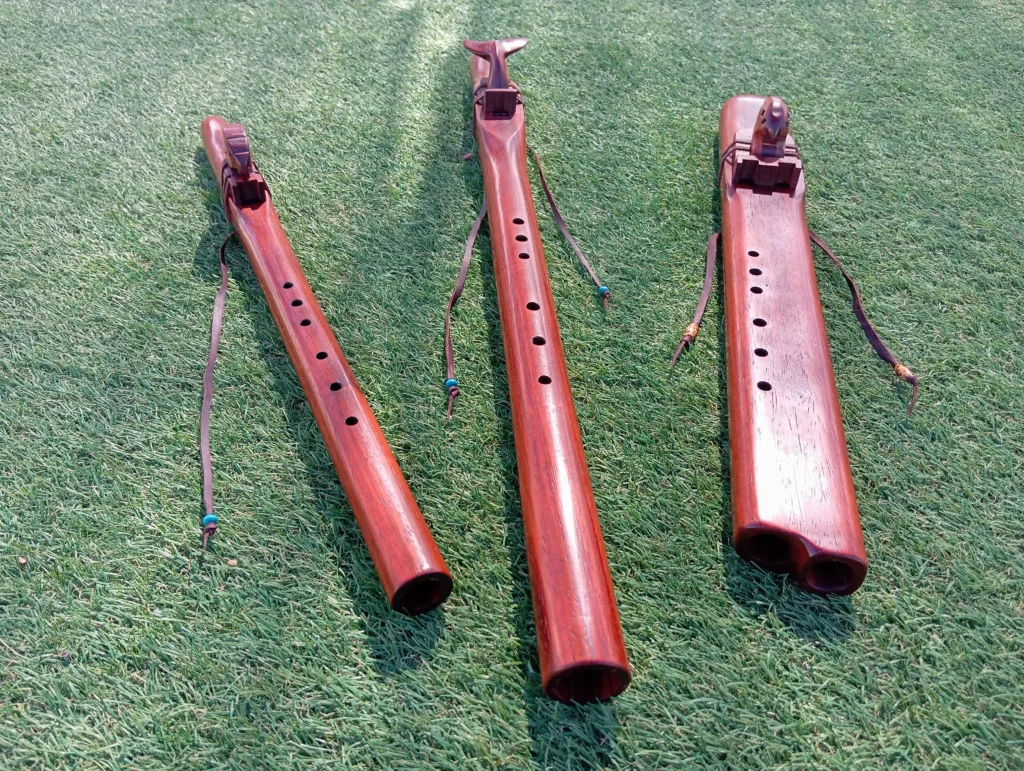
When we say Native American flute, we mean the traditional two-chamber flutes that come from the Indigenous peoples of North America. First of all, we would like to make something clear: although the flutes we make are based on this type of construction, strictly speaking they are not Native American flutes but are inspired by them, since they are made in Spain by people with no Native American ancestry. We think it is important to say this out of respect for Indigenous peoples and their traditions. We use the instrument’s most common name for practical reasons, with no intention of claiming the term as our own, and hoping that in some small way we can help honour this instrument and the tradition it comes from.
The Native American flute is a simple but deep instrument, intuitive to play and warm in sound. Almost from the very first moment, it invites you to improvise and to connect with “that” which we are all looking for. That is why it can be a great tool for introspection, and also for offering others what we all carry inside.
There can be as many flutes as there are different needs, so it helps to know how to identify them in order to find the flute that suits you best: your hands and the way you breathe. So, after a few basics, we start with you and then talk about the flute.
In short: to choose a Native American flute, start with yourself (your hands, the way you breathe and what you want it for), and then look at the flute: key, 5 or 6 holes, single or double, material and finish. If it is your first flute, a mid-range flute (between F4 and A4), single, with 6 holes and tuned to 440 Hz is usually a good starting point. If you have small hands or want it for travelling, a high flute with 5 holes is just as good a way in.
The basics: key and size
What the key is
The key tells you which note the flute is built on. We normally define it by its lowest note, the one you hear when you blow with all the holes covered. This note is usually the root of the scale the flute plays: a flute in A minor, for example, has A as its base note. It is easy to check: just play it in front of a tuner.
Size and key
The size and the key of a flute are closely related, but they are not exactly the same thing, and it is worth understanding why.
What does that note depend on? Mainly on the sound chamber, the part of the flute that runs from the plug, just below the window where the sound is born, to the end. The longer that chamber, the lower the flute sounds. But that is not all that counts: the inner diameter also plays a part. At the same length, a wider flute sounds a little lower than a narrower one. That is why, between neighbouring keys, a lower flute does not have to be longer than a higher one.
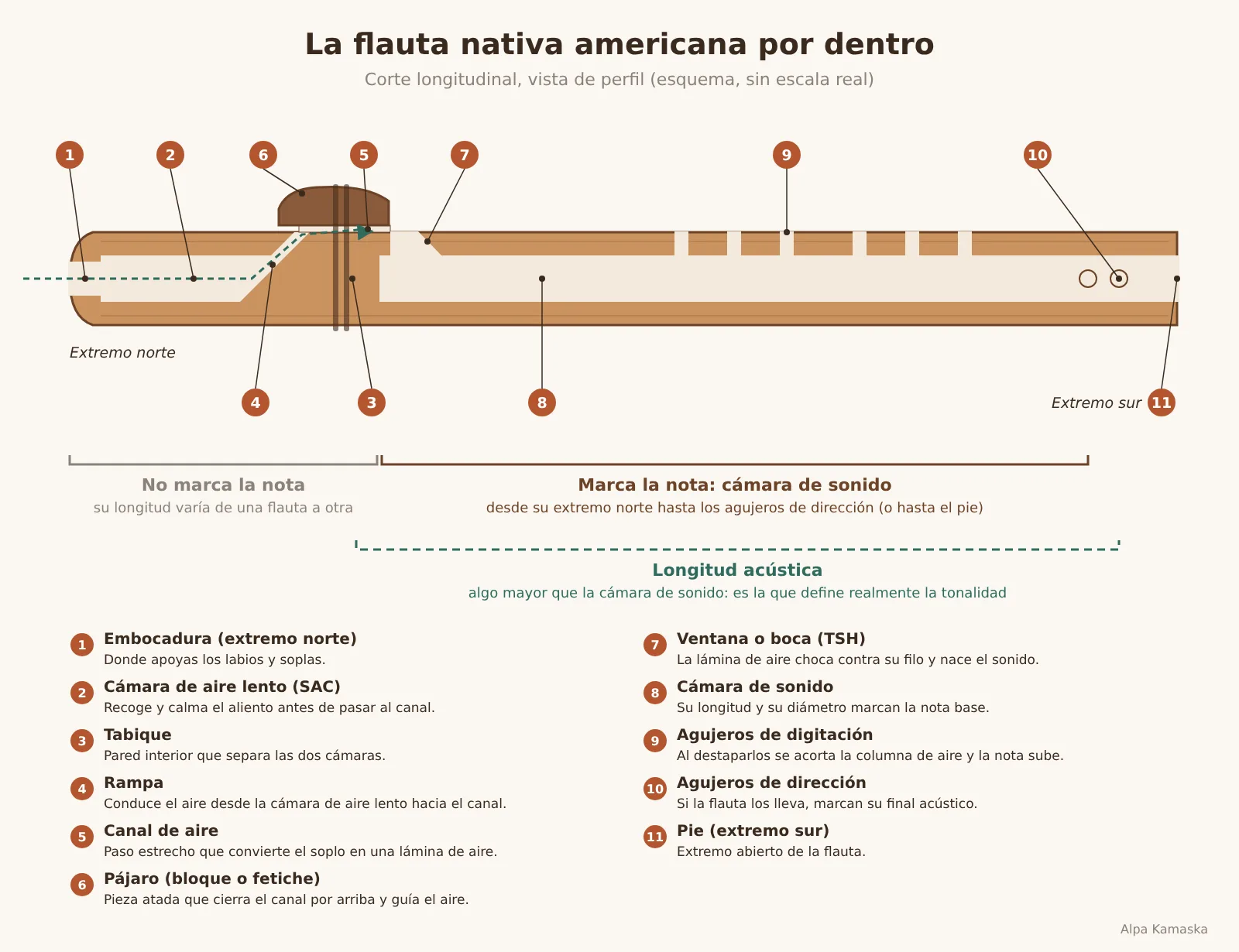
On top of that, the air vibrating inside the flute behaves as if the tube were a little longer than it really is. This measurement is called the acoustic length. It is somewhat longer than the sound chamber, and it is what really defines the key.
Nor is the sound chamber the whole flute. In front of it are the mouthpiece, the slow air chamber, the ramp and the flue, and their length changes from one maker to another, and even from one flute to another. A flute can be longer simply because it has a longer slow air chamber, without that making it any lower.
Something similar happens with direction holes, holes near the foot that some flutes have. When they are there, the sound “ends” at them, and the length of wood below them makes the flute longer without making it lower. We do not usually make them, but it is good to know if you are comparing flutes from different makers.
Even so, as a general rule it holds true: the longer the flute, the lower it sounds. The exceptions appear mainly between neighbouring keys. Between a flute in C4 and one in E5 there is no doubt: the low one is much longer.
Low, mid and high flutes
Throughout this article we talk about low, mid and high flutes. So that we understand each other from the start, this is how we usually group them at Alpa Kamaska:
Type | Usual keys | Size | Holes (what we usually make) |
Low | E4 and lower (D4, C4…) | The longest | 6 |
Mid | F4 to A4 (F4, F#4, G4, G#4, A4) | In between | 6 |
High | A#4 and up (B4, C5, D5, E5…) | The smallest | 5 |
The number after each note shows the octave. For reference, A4 is the A in the middle of the piano, at 440 Hz.
This classification is just one way of ordering them, not a rule. The limits are relative and other makers may group them differently. For example, Flutopedia, one of the most complete references on the Native American flute, considers the whole octave from C4 to B4 as mid-range. What matters is the underlying idea: in general, the lower a flute, the longer it is, and the higher, the smaller.
Beyond the technical side, each register has its own character. Low flutes sound deep and enveloping. Mid flutes, warm and balanced. High flutes, bright, light and very expressive.
Things to consider before choosing
Before looking at the flute, it is worth looking at yourself. Some things depend not on the flute but on your body and your journey, and they will affect how comfortable it is for you to play.
Your hands
On low flutes the holes are further apart, because the flute is longer. With small hands or short fingers it can be hard to cover them properly, and if a hole is not fully covered, the note does not come out cleanly. On high flutes it is the opposite: the holes are closer together and easier to cover. If you are unsure, the best thing is to pick up the flute and try placing your fingers.
Your breath
Each flute asks for a different breath. Low flutes need more air and a slow, sustained breath. High flutes need less air and a little more pressure. On a double flute the air is shared between two flues, so it also needs a bit more, which becomes more noticeable the longer the flute is. None is better than another. It is about finding one that fits the way you breathe and lets you manage the air you blow into it well. And for that too, the flute can be a good teacher for connecting with your breathing, with your breath.
Your voice
If you like singing or humming while you play, or alternating voice and flute, look for a key close to your vocal range.
Your musical experience
You do not need to know music to play the Native American flute. Even so, the number of holes changes the experience a little:
- 5 holes: its basic scale is the minor pentatonic, a five-note scale in which almost any combination sounds good. It is very easy to start improvising without fear of hitting a wrong note. With cross-fingerings (less obvious finger combinations) you can also get other notes, but they only appear if you look for them. At Alpa Kamaska we usually make our high flutes with 5 holes.
- 6 holes: adds notes outside the pentatonic scale. That opens up more possibilities, but also more chances of a note not fitting, and it is easier to make the most of with some musical background. The good news is that if you keep one hole covered all the time (with your finger or by tying a leather strip over it), you play the same pentatonic as on a 5-hole flute. So you can start simply and add notes whenever you feel like it. We usually make 6-hole flutes in mid and low keys.
We especially like 6-hole flutes, because they contain the 5-hole one and let you grow with them, although it is true that, in many cases, most of the time we play purely pentatonic melodies that can be played on a 5-hole flute. We also usually optimise our flutes to play all the notes their design allows, so most of our flutes, both 5 and 6-hole, can play chromatic notes in addition to the pentatonic scale. This does not mean our flutes are chromatic, but it does mean that, in general, we can play several notes outside the pentatonic scale in tune. Later on we will write an article about the notes, scales and modes of the Native American flute.
What you want it for
The next step is to think about how you will use it. Here are some pointers from our experience. Take them as a guide, not a rule: some people fall in love with a low flute as their first flute, and that is perfectly fine.
- For everything, or a first flute: if you are looking for a flute to keep you company at home, in nature or in a circle, and you do not yet know where it will take you, the most balanced choice is usually a mid-range, single, 6-hole flute. It is comfortable, versatile and lets you grow. If you have small hands, a high 5-hole flute may be a more comfortable start.
- Travel: if you are going to carry it in your backpack, size and weight count. A high flute, or one of the higher mid-range ones, single, is easier to carry. A tough finish also helps it cope with the bustle of travel. It is also worth noting that, on a flute meant to be easy to carry, a bird with a flatter shape makes transport much easier, as more complex or taller birds can be bulkier and more fragile.
- Sound bath: here you usually want a deep, enveloping sound, so low flutes or the lower mid-range ones work well. The double flute, with its constant background note, adds a lot in this setting. Bear in mind, though, that low flutes need bigger hands and more air, as we saw in the previous section.
- Playing with others: if you are going to play in a group, with guitar, singing bowls or other flutes, the most practical option is a mid-range flute tuned to 440 Hz, in a key that fits the group. A 6-hole flute gives you more notes to accompany with.
The flute
Material
Wood
Wood gives the flute a warm, organic sound with presence, and brings different nuances depending on the type of wood it is made from. Speaking very generally, two flutes built identically, one in dense wood and the other in less dense wood, will tend to sound a little different: the dense one will have a slightly more defined, projected sound, while the less dense one will sound a little more “diffuse” and vibrant. This example, clear in theory, is in practice influenced by many factors related to the construction parameters and geometry of the flute, which are often even more decisive than the type of wood.
At Alpa Kamaska we usually work with padauk, utile and tatajuba, although we are not limited to them and we like to experiment with other woods.
- Pros: warm sound with presence, each piece is unique in colour and grain, it absorbs some of the moisture from your breath and, if the finish gets damaged, it can be renewed or repaired.
- Cons: it is sensitive to sudden changes in humidity and temperature, needs some care and is usually heavier and more expensive than bamboo or plastic.
Bamboo
Another of the most common materials for Native American flutes. Bamboo flutes are usually lighter than their wooden counterparts. The bamboo stem is made up of nodes and hollow, almost cylindrical sections between them, which makes construction much easier, since one of the nodes can be used as the wall between the two chambers, and the naturally hollow section as the body of the flute. This can be an advantage, as it saves part of the work, although it calls for other ways of working.
As for sound, bamboo flutes have a characteristic timbre, which comes from the material itself and, to a greater extent, from what the flute is like inside: they usually have a less evenly round bore and keep traces of the nodes, which makes the air more audible as part of the note. It is a very organic, almost “sandy” sound, with a little less body and presence than wooden flutes. This does not mean at all that they sound less or worse. They simply have a characteristic timbre that we personally love, although we do not usually use this material because of availability.
- Pros: it is light, has a very organic timbre and is a fast-growing, renewable material.
- Cons: it tends to crack with changes in humidity, its irregular inside makes precise tuning harder and each cane is different, so there is less consistency between flutes.
Plastics
There are also plastic flutes, either made from PVC pipe or 3D printed. They are affordable, light and unaffected by humidity, which makes them practical for beginners, for travelling or for children. Their sound is usually cleaner and brighter, and a little less warm than wood. On the downside, plastic absorbs none of the moisture from your breath, so the flue gets wet sooner, and some plastics warp with heat, for example inside a car in the sun.
- Pros: affordable, light, resistant to knocks, unaffected by humidity and easy to wash. When 3D printed, two flutes of the same design also come out practically identical.
- Cons: the flue gets wet sooner, some plastics warp with heat, the sound is less warm, it is less pleasant to the touch, and it is plastic, with the environmental impact that implies.
Single or double
- Single: one flue and one voice. It is the most traditional design and the simplest to start with.
- Double: two chambers that sound at the same time. One plays the melody and the other holds a constant background note, the drone. The sound is richer and more enveloping, but it needs a little more air and some practice.
If it is your first flute, we usually recommend starting with a single one. Even so, a double flute can be a good first flute if you are especially drawn to it for sound baths or meditation.
- Single, pros: easier to play, lighter and more affordable.
- Single, cons: one voice, with no background accompaniment.
- Double, pros: a richer, more enveloping sound, with a drone that accompanies you as you play.
- Double, cons: needs more air and more practice, and is usually heavier and more expensive.
440 or 432 Hz?
Most instruments today use A at 440 Hz as their reference, and that is how we tune our flutes. Some people prefer the 432 Hz reference. A flute at 432 sounds slightly lower (almost a third of a semitone), so it works well on its own or with instruments tuned the same way, but it will not fit with guitars, pianos or other flutes at 440. If you are interested in one at 432, let us know and we will look into it. We will talk about this difference in more depth in an article of its own.
Finishes
The finish protects the wood from the moisture of your breath, the sweat of your hands and daily use. It also changes how the flute feels and looks. Its effect on the sound is small: where you really notice it is in the protection and in the care the flute needs over time.
The most common finishes
- No finish: bare wood. It is the most natural and lovely to the touch, but it is exposed to moisture and dirt, and the wood moves more.
- Drying oils (linseed, tung): they soak into the wood and harden in the air. They give a natural look and are easy to renew, although they take time to cure and offer little protection against water.
- Mineral oil (liquid paraffin): it does not dry or go rancid and is very easy to apply. In return, it protects little and has to be reapplied often.
- Waxes (beeswax, carnauba): they leave a smooth feel and a satin sheen. They protect little on their own and wear with use, so they are usually combined with other finishes.
- Oil and wax blends (balms): they combine the best of both: the oil nourishes and the wax seals the surface a little. They are easy to renew at home, but their protection is moderate.
- Shellac: a natural resin dissolved in alcohol and applied in thin coats. It dries quickly, gives a warm tone and is easy to repair, but it does not get on well with alcohol, heat or prolonged contact with water.
- Varnishes and lacquers (polyurethane, nitrocellulose, water-based varnishes): they form a hard film over the wood. They protect very well and need hardly any maintenance, but they feel less natural and, if damaged, are harder to repair.
The ones we use
There is no perfect finish: each one is a balance between protection, feel and maintenance. So we work with three, depending on the flute. Inside, the chambers have several coats of shellac with wax on top, and the flue has shellac only. On the outside, each flute has one of these finishes:
- Homemade balm: we make it ourselves with liquid paraffin, beeswax and carnauba wax. The oil nourishes the wood and the waxes give it a silky feel and some protection.
- Pros: it brings out the grain, feels lovely and you can renew it yourself at home with a cloth.
- Cons: it protects less than shellac or varnish and needs reapplying now and then.
- Shellac: a natural resin secreted by a small insect, the lac bug, which we dissolve in alcohol. We apply it in many thin coats, which form a fine, warm film.
- Pros: it is natural, gives a warm tone, protects more than an oil and can be repaired by adding new coats.
- Cons: it is sensitive to alcohol, heat and prolonged contact with water. In our experience, it also wears sooner at the mouthpiece, the area in contact with the lips.
- Polyurethane varnish: a synthetic varnish we spray on, which forms a hard, glossy layer.
- Pros: it offers the most protection against moisture, knocks and rubbing, and needs hardly any maintenance. It is a good option for travel or heavy use.
- Cons: it feels less natural and, if it gets scratched or knocked, it is harder to repair.
A note: we have not been making flutes for long enough yet to know whether the shellac and wax inside will last the flute’s whole life or will need renewing over time. We will share what we learn as we go.
If you would like to know how to care for your flute and its finish day to day, we explain it in our article on Native American flute care.
Before you decide
The bird
On top of the flute you will see a piece tied on with a leather strip: the bird, also called the block, totem or fetish. It is not just decorative. It helps direct the air towards the edge where the sound is born, and its position affects how the flute sounds.
So it is good to know that if it moves or the tie comes loose, the flute may stop sounding right or sound very airy. It is not a fault: putting it back in place is almost always enough. When you choose your flute, ask to be shown how it sits. It will save you more than one fright.
Listen to it
Every handmade flute is unique. Even if two flutes have the same key and the same wood, they do not sound exactly alike. So whenever you can, listen to it before you choose: in person, at one of our workshops or with a recording or video of that specific flute, not of a generic model.
This is one of the differences between a handmade flute and a mass-produced one, a subject we will devote an article to.
What about the price?
It is normal to find quite a difference in price between flutes. Without going into figures, this is what matters most:
- Material: wooden flutes are usually more expensive than bamboo or plastic ones, because of the material and the work they involve.
- Details and extra work: decorative details or inlaid woods take more hours of work and make the flute more expensive.
- Single or double: a double flute takes considerably more work than a single one, and that shows in the price.
- Finish: some finishes need more coats, more drying time or more steps than others.
- Handmade or mass-produced: a handmade flute is built, adjusted and tuned one by one, and that takes time.
Rather than looking only at the price, think about how you will use it and what the flute gives you when you play it.
To sum up
Before you decide, go through this quick checklist:
- Use: what you want it for.
- Your body: your hands, your breath and your voice.
- Your experience: 5 or 6 holes.
- Key: low, mid or high.
- Type: single or double.
- Material and finish: wood, bamboo or plastic, and how it is protected.
- Tuning: 440 or 432 Hz.
- Listen to it: whenever you can, before you choose.
You do not need to get everything right the first time. If it is your first flute, a mid-range, single, 6-hole flute tuned to 440 Hz is usually a very balanced starting point. If you have small hands or want something easy to carry, a high 5-hole flute is just as good a way in.
Rather than looking for “the best flute”, we invite you to look for the one that suits you, your way of playing and the path you want to walk with it.
Frequently asked questions about how to choose a Native American flute
Which Native American flute is best for beginners?
From our experience, a mid-range flute (between F4 and A4), single, with 6 holes and tuned to 440 Hz. It is comfortable, versatile and lets you grow. With small hands, a high 5-hole flute is usually more comfortable.
Is a 5-hole or a 6-hole flute better?
The 5-hole flute plays the minor pentatonic scale, in which almost any combination sounds good, so it is very easy to start improvising. The 6-hole flute adds notes outside the pentatonic. If you keep one hole covered, you play the same as on a 5-hole flute and can add notes whenever you like.
What is the difference between a single and a double Native American flute?
The single flute has one voice and is the simplest to start with. The double flute has two chambers that sound at the same time: one plays the melody and the other holds a constant background note, the drone. It sounds more enveloping, but needs a little more air and practice.
Do you need to know music to play the Native American flute?
No. It is an intuitive instrument that invites you to improvise from the very first moment, especially 5-hole flutes.
Which Native American flute is best for sound baths?
Low flutes or the lower mid-range ones usually work well, for their deep, enveloping sound. The double flute, with its constant background note, adds a lot in this setting. Bear in mind that low flutes need bigger hands and more air.
Are the flutes tuned to 440 or 432 Hz?
We tune our flutes to 440 Hz, the reference for most instruments today, so you can play with guitars, pianos or other flutes. If you are interested in one at 432 Hz, let us know and we will look into it.
Not sure which flute is right for you? At Alpa Kamaska we make handmade Native American flutes, one by one, and we also take custom orders. Write to us and we will help you find yours.
