
The flute player and the alchemy of air into melody
How air becomes melody: a journey through the body and the Native American flute
In this article we want to tell the story of a journey: the journey of the air. That air is all around us, freely available, part of the earth. It is the same air that enters the flute player’s body, moved by an intention, and is shaped until it is transmuted. To make this happen, human beings have even had to imagine and build a tool: an instrument. At the end of the road, that air is no longer “just” air: it is an audible feeling that expresses something of the same nature that created it.
It is a small alchemy. Let’s follow it stage by stage: first through the body, then through the flute.
In short: this is how the Native American flute works: the player’s breath settles in a first chamber, speeds up along the ramp and leaves the flue as a thread of air that oscillates against the edge. That back-and-forth makes the air inside the tube vibrate, and the holes the player uncovers decide the note.
1. It begins in the flute player
Before the air, an intention
Everything begins with an intention, a feeling, a connection. Before the first breath of air goes in, the flute player already knows, or senses, what they want to sound: what they are feeling, what binds them to that music, what they want to convey. Sometimes it has a name and sometimes it doesn’t, but it is there in the background and colours everything.
To describe what happens in the body we have drawn on Michel Ricquier’s Tratado metódico de pedagogía instrumental (a methodical treatise on instrumental teaching), a method for wind players devoted to breathing and the air column (the full reference is at the end). Ricquier asked his students to hear the note inside before playing it: not only its pitch, but also its colour. Something similar happens with the Native American flute: first you feel what you want to say; then the air carries it.
Breathing in: the air goes down
The air the flute player breathes in, whose oxygen was once made by tiny algae and, later, by plants, is the air that is simply there, all around: the air of the earth, available to every living being. They feel it enter their body as if it passed straight through the skin, drawn in by the suction of the diaphragm. (This is an image Ricquier suggests: imagine that the air does not pass through the mouth, but enters through an imaginary opening in the throat, at the hollow just above the breastbone, and from there drops vertically down to the pit of the stomach.)

As it goes down, the flute player feels the air expand their waist: at the front, at the sides and even at the back. And all the while they are listening, feeling the murmur of their breathing, a low, deep “onnn”.
Blowing: the support, the engine that feeds the flute
The engine starts. The muscles of the abdominal wall contract and push from below, the diaphragm relaxes, and the pressure built up inside drives the air outwards, towards the flute.
The air column: always downwards
And here is the curious part. Although the air rises to get out, the flute player has the opposite sensation: a firm support and a downward push of the air column, from the hollow above the breastbone to the pit of the stomach. (Ricquier calls it vertical push and describes it as a sensation, not as what physically happens: an image that organises the body without having to think about every muscle.)
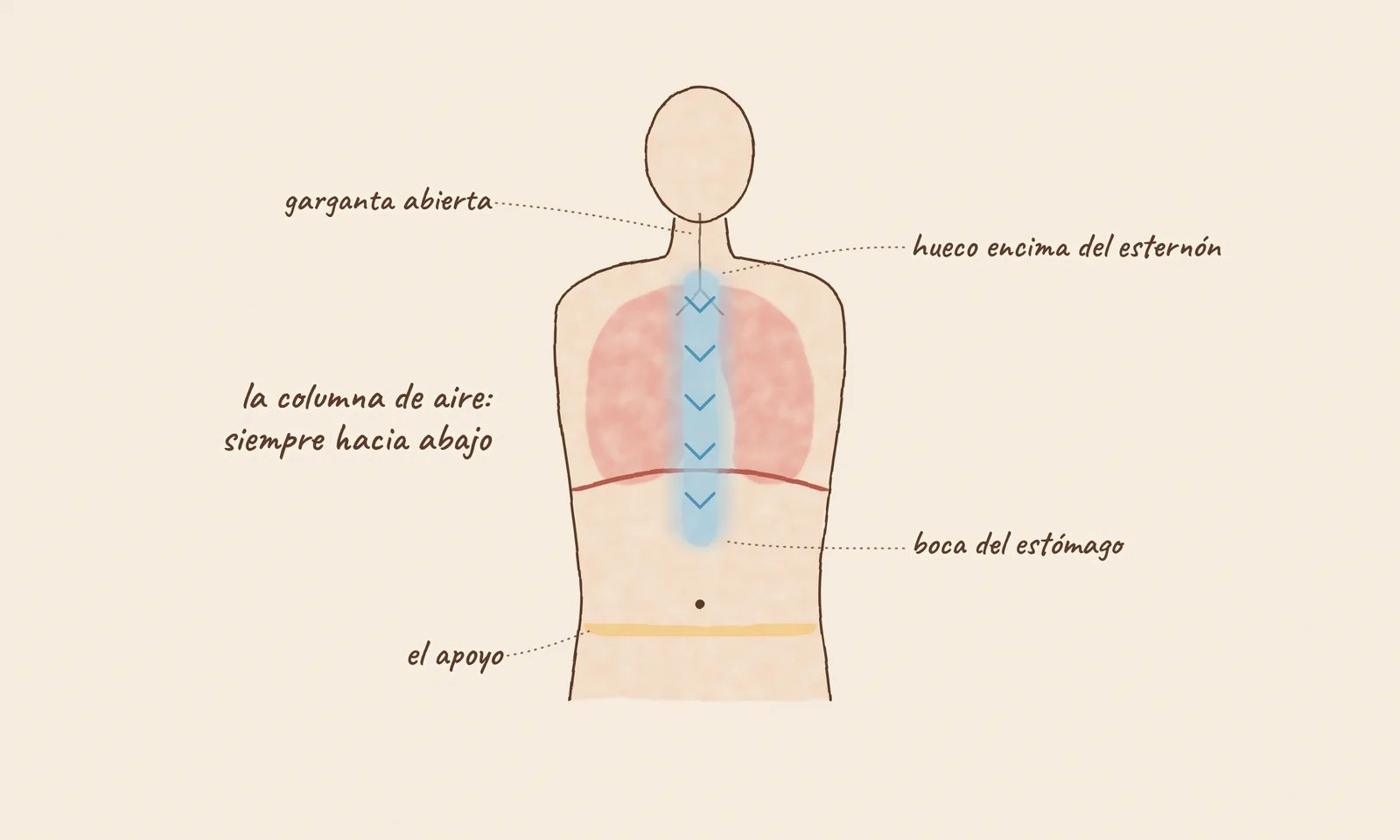
The resulting breath is gentle, but steady and confident.
The way out: a clear path
The air begins its way out. The pressure pushes it out: it passes through the bronchi, rises up the windpipe, crosses the larynx and the throat, goes through the mouth and leaves between the lips without meeting any obstacle on its way. It fills relaxed, wide cavities: the throat open as in that “onnn”, the tongue loose and back, the jaw slack, the face calm and the lips around the mouthpiece without squeezing.
The flute player feels the breath go straight into the centre of the mouthpiece hole, without brushing the edges. It is the ease of someone who feels: the air flows and the note stays still, settled.
2. The first chamber: a breather
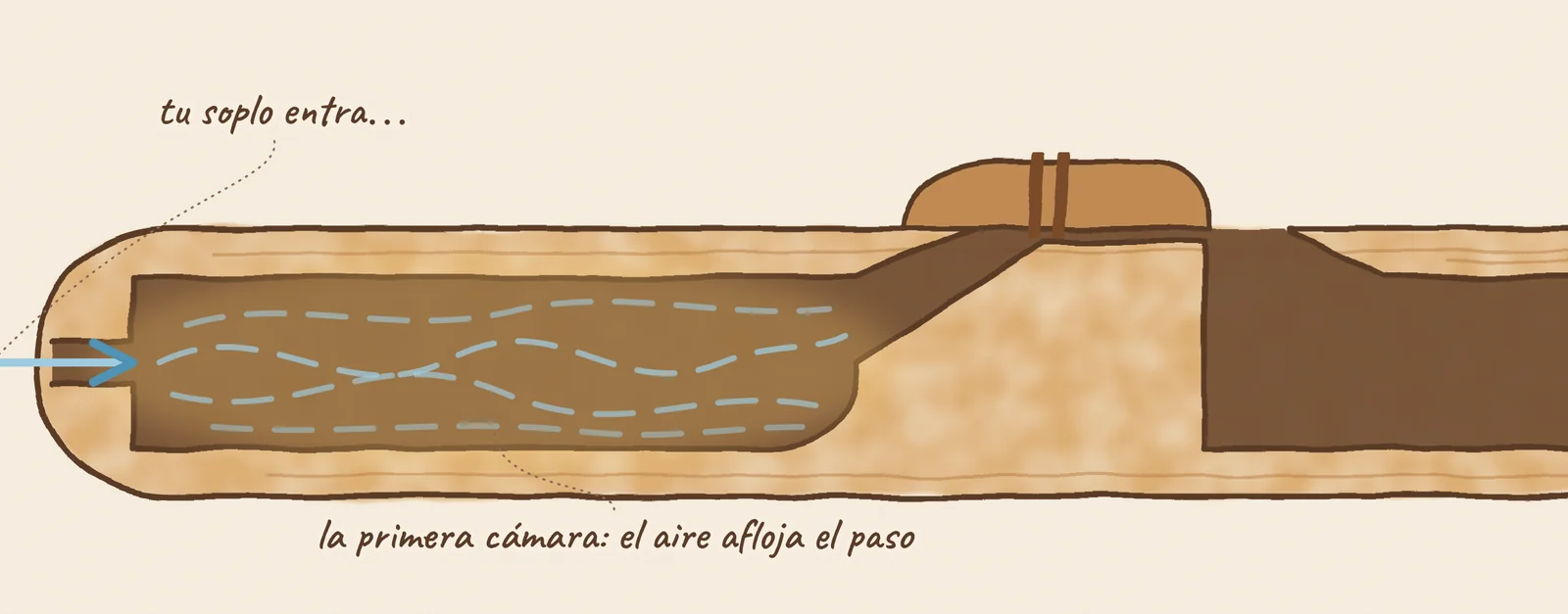
The air enters through the mouthpiece and reaches the first chamber, which flute makers call the SAC (slow air chamber). And in there, suddenly, there is room. The air does what anyone would do stepping out of an alley into a square: it slows down.
This chamber works like a still pool. It gathers the player’s breath, with its little tremors and its hurry, and calms it before letting it move on. We like to think that this is why the Native American flute is so generous to beginners: the breath never reaches the place where the sound is born in a raw state.
That is why the flute player feels a slight resistance when blowing, as if the flute were giving back a little of the air. It does not come from this chamber, which only fills up and waits, but from the narrow passage that comes next.
3. The ramp: everything speeds up
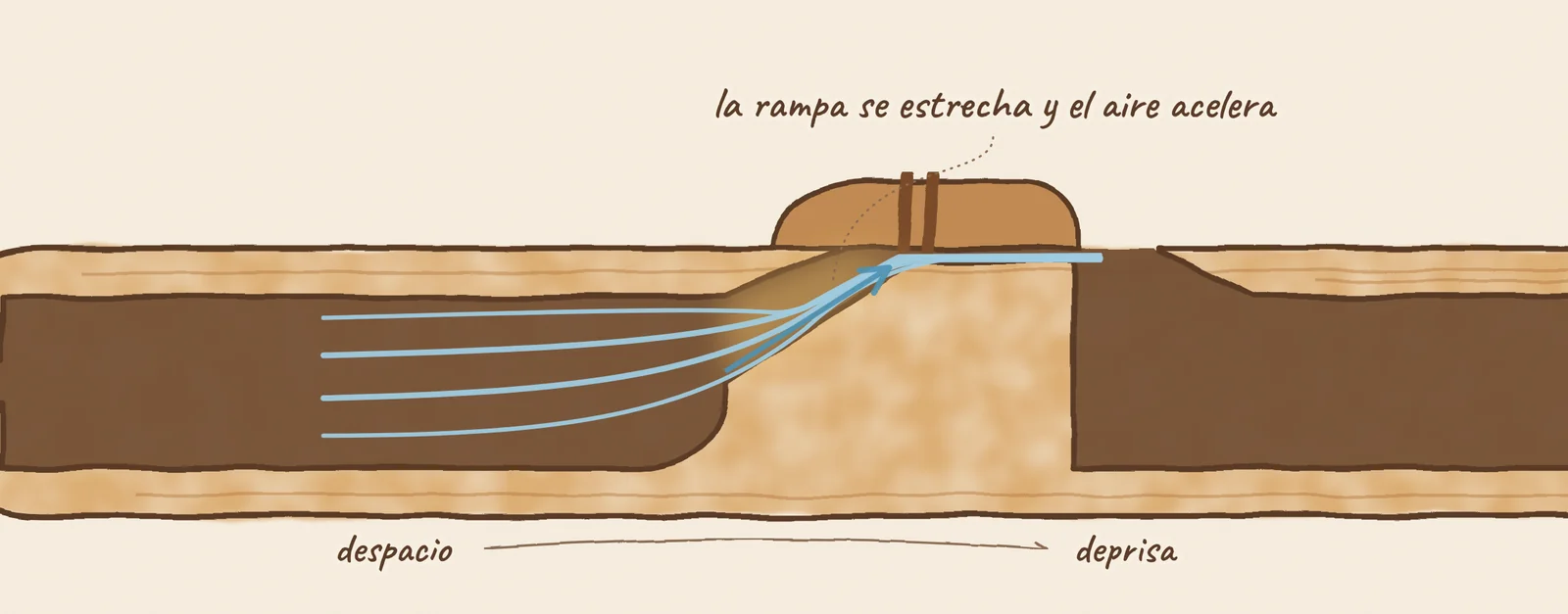
At the far end of the square a street opens up, getting narrower and steeper. This is the ramp. And here something happens that governs the whole journey: the narrower the passage, the faster the air goes. We see it in any river squeezed between two rocks: the water does not stop, it rushes. The pressure the flute player put in with their belly turns, moment by moment, into speed.
That is why in the workshop we treat it with great care. A step or a burr here is a stone in the road, and we suspect that air that trips over them carries on its journey in turmoil.
4. The flue: a thread of air
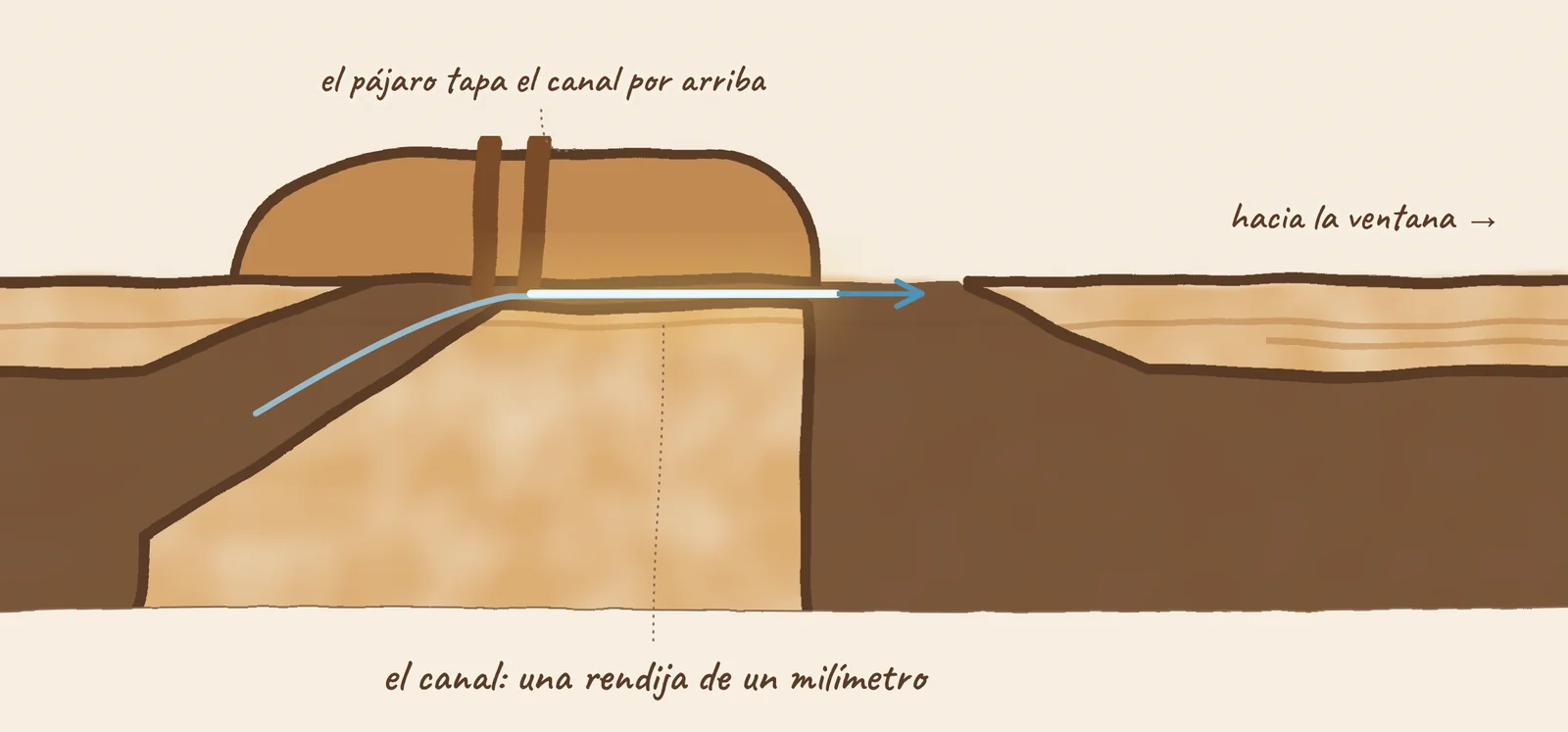
We reach the most delicate stage. The flue is about a millimetre high: a little more than the thickness of a credit card. Through that slit the air comes out as a very thin sheet, like water escaping under a door.
And it travels in a fragile balance. We sense that this jet lives right on the border between staying orderly and becoming chaotic. That is why anything disturbs it: a splinter, a speck of dust, a drop.
A single drop is enough. When, after playing for a while, the note starts to sound breathy or to gurgle, there is almost always water in this flue. It is not the fault of the flute player or their hands: it is the thread of air, which has tripped.
5. The window: a few millimetres of flight
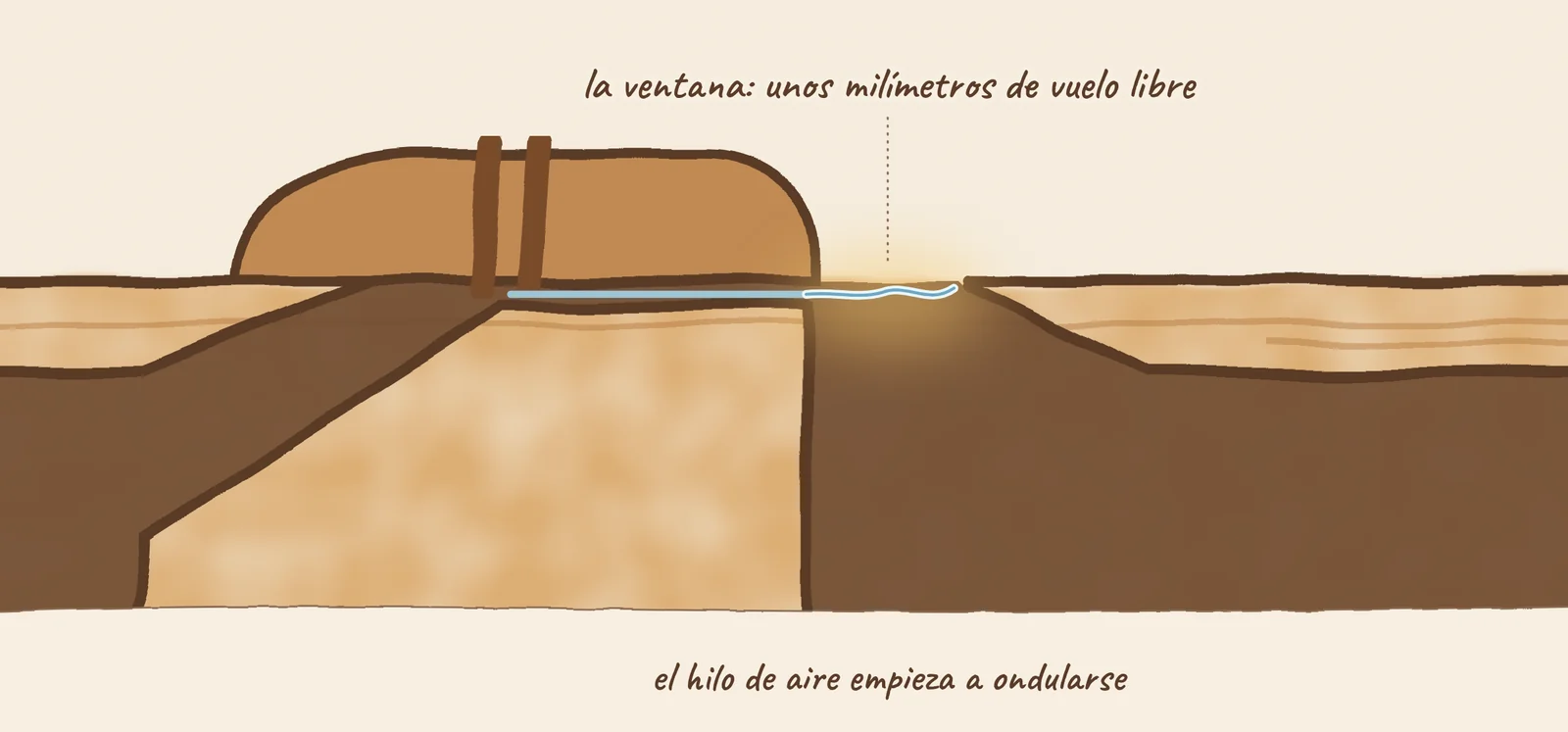
As it leaves the flue, the thread of air looks out over the void: the window. For a few millimetres it flies free, with no walls, nothing to guide it. And in that flight it starts to ripple, like a flag in the wind.
It takes less than a thousandth of a second to cross. It seems like nothing, and yet everything is decided there, because the flute lives on arriving on time. If the air crosses at its own pace, the note sounds. If the flute player blows too hard, it arrives too early and the flute jumps to the octave: this is what we call overblowing.
The flute player perceives it as a note that “wants to go up”: it is the air arriving too soon. So they ease off a little, without losing the support, and the note goes back to its place.
6. The edge: where the voice is born
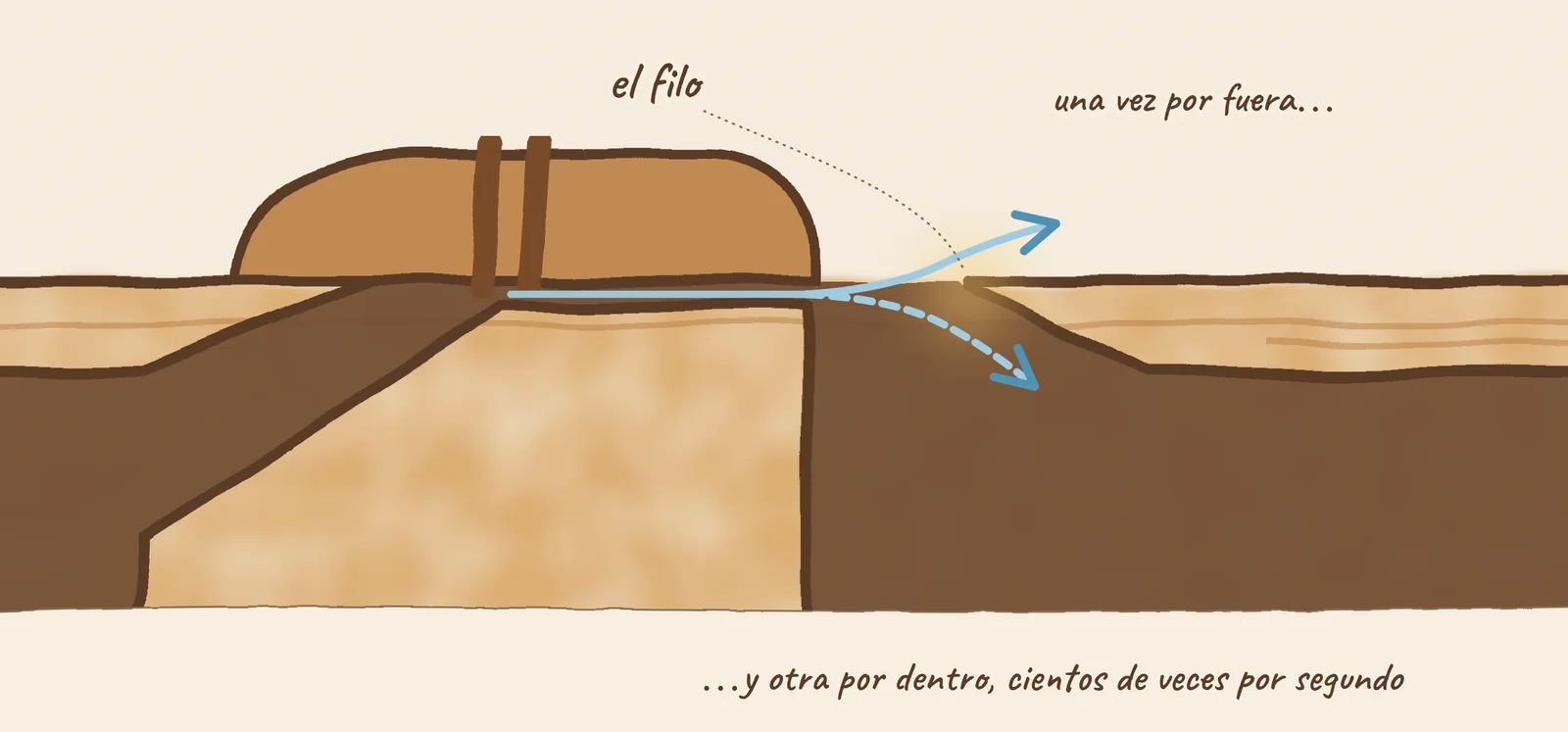
On the other side of the window the edge is waiting: a ridge of wood. The thread of air, rippling, passes once above it and once below, again and again, hundreds of times per second, more the higher the note. Each time it goes in, it pushes the tube; each time it goes out, it lets it breathe.
It is like a swing that someone gives a little push at just the right moment: you don’t need to push hard, you need to push on time. From that back-and-forth the sound is born.
And from the exact point where the edge cuts the air, its colour is born. A little higher or a little lower, and the same flute sings sweeter or brighter. As flute makers, we look for that sweet spot.
Many flute players imagine the jet entering the edge cleanly, like a ball going into the basket without touching the rim. We do it too. We don’t know whether that changes anything in the physics, and we are not going to say it does, but we notice that with that image the breath comes out steadier and more focused. It is the same thing Ricquier said: give the body an image and it organises itself.
That idea seems to us one of the most powerful of the whole journey. As Ricquier puts it, imagination is powerful and, in general, we don’t know how to use it. While playing, the flute player cannot keep track of every muscle; what they can do is give the body a clear image and let it find the way. The air column going down, the note heard inside before playing it, the ball going cleanly into the basket: they are images, not orders, and the body understands them better.
7. The tube: the air becomes melody

Each of those little pushes wakes a wave that runs along the tube, bounces at the other end and comes back. It is like an echo in a well, but so fast that it becomes a note. The note that sounds depends on the length of the vibrating tube, and that length is set by the flute player’s fingers. With all the holes covered, the wave travels the whole tube and the lowest note sounds. Each hole they uncover gives the wave an earlier way out: its journey gets shorter and the note goes up.
Here is the loveliest paradox of the whole journey: the air of the breath hardly moves forward inside the tube. What travels is the vibration. Like in a stadium when the crowd does the wave: nobody leaves their seat and yet the wave goes all the way round.
Sometimes the flute player feels it in their hands: the wood vibrates under their fingertips. It is the melody passing beneath their fingers.
8. The way out
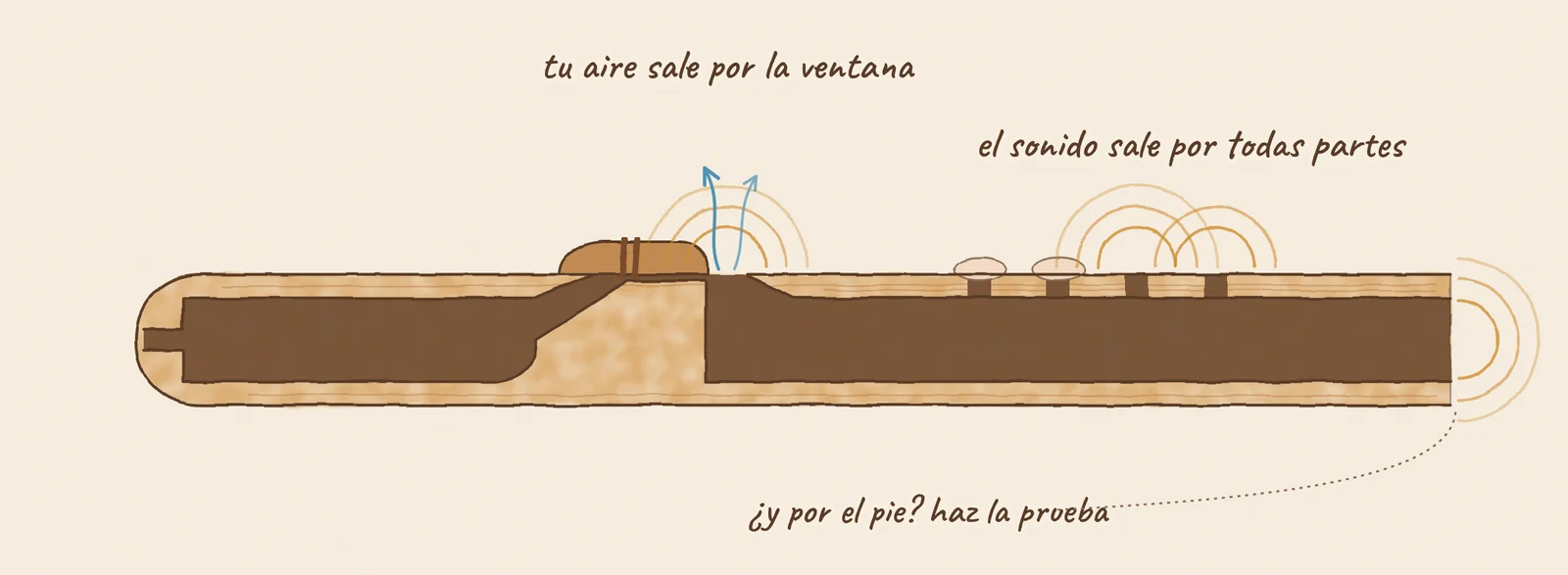
In the end, the sound leaves wherever it can: through the open holes, through the foot and through the window itself. The flute player’s air, on the other hand, we believe leaves almost entirely through the window, without travelling along the tube.
Here we suggest a game, because we haven’t fully tested it either. While playing, the flute player can hold a palm in front of the window and then in front of the foot. Where do they feel the draught? The sound comes out of both places; the wind, perhaps not so much. If anyone tries it, we would love to hear what they notice.
When you play again
The next time the flute player picks up the flute, they won’t just blow: they will accompany their air. It is born from an intention, goes down with it, finds its support, rests in the first chamber, hurries along the ramp, sharpens in the flue, flies across the window, dances on the edge and becomes melody in the tube.
And when something doesn’t sound the way they want, they don’t rush to blame the flute or their hands. They retrace the path stage by stage, starting with themselves. Very often, that is where the answer lies.
We are curious flute makers, not physicists. What we tell here is what we have learnt, explained as simply as we can. Where something is a hunch and not a certainty, we say so.
Frequently asked questions about how the Native American flute works
How does the Native American flute work?
The air leaves the flue as a thin sheet, crosses the window and passes again and again above and below the edge, hundreds of times per second. That back-and-forth makes the air inside the tube vibrate, and that is what you hear.
What is the first chamber (SAC) for?
It gathers the breath and calms it before letting it into the flue, so the small tremors of the breath do not reach the place where the sound is born in a raw state.
Why does my flute sound breathy or gurgle?
There is almost always water in the flue: a single drop is enough to disturb the thread of air. We explain how to dry it in Native American flute care.
Why does the note jump to the octave?
Because the breath is too strong and the air crosses the window too early. Simply ease off a little, without losing the support.
What decides the note that sounds?
The length of the vibrating tube, which is set by the fingers: with all the holes covered the lowest note sounds, and each hole you uncover makes it go up.
How should you breathe to play?
When breathing in, the air goes down and opens the waist; when blowing, the abdominal wall pushes, with the throat open and the lips relaxed. The resulting breath is gentle, but steady.
Reference
Ricquier, Michel. Tratado metódico de pedagogía instrumental. Principios fisiológicos y psicológicos de la columna de aire. Second edition, with a preface by Maurice André. Spanish translation.
