Wood or plastic flute: does the material change the sound? We measured it

It’s a question we often ask ourselves in the workshop: wood or plastic flute, is there really a difference? Does a wooden flute sound different from a plastic one? Does the material change the sound?
First, a word about who we are. We make flutes, but we’re not luthiers, or cabinetmakers, or a specialised factory (we have great respect for them all). We’re enthusiasts who love building flutes. We take as much care as we can over every step and try to be precise, but within our means and our experience, and someone with more craft would surely improve on our methods. We’re not acoustics experts either.

What we do have is curiosity. Building flutes raises questions, and we like to understand and dig deeper into what we’re doing. So we took one of our wooden flutes, copied it in plastic with a 3D printer, and recorded and measured both. Then we read what the people who really know about this have studied.
Here we share what came out, what can be claimed and what can’t. And at the end, my personal opinion, which is just that, an opinion.
In a nutshell. The plastic copy sounds different. In the low notes it’s somewhat brighter, because two of its harmonics, the 2nd and the 4th, are louder. The amount of breath noise is the same. Most likely it’s not because it’s plastic, but because a copy is never identical to its original, and those two harmonics are precisely the ones that depend most on the shape of the area where the sound is born. According to the research, the wall material plays a secondary role in the sound of a flute. Even so, the player does feel differences, and that counts too.
The video is in Spanish, with English subtitles: turn them on with the CC button in the player.
The flutes in the test
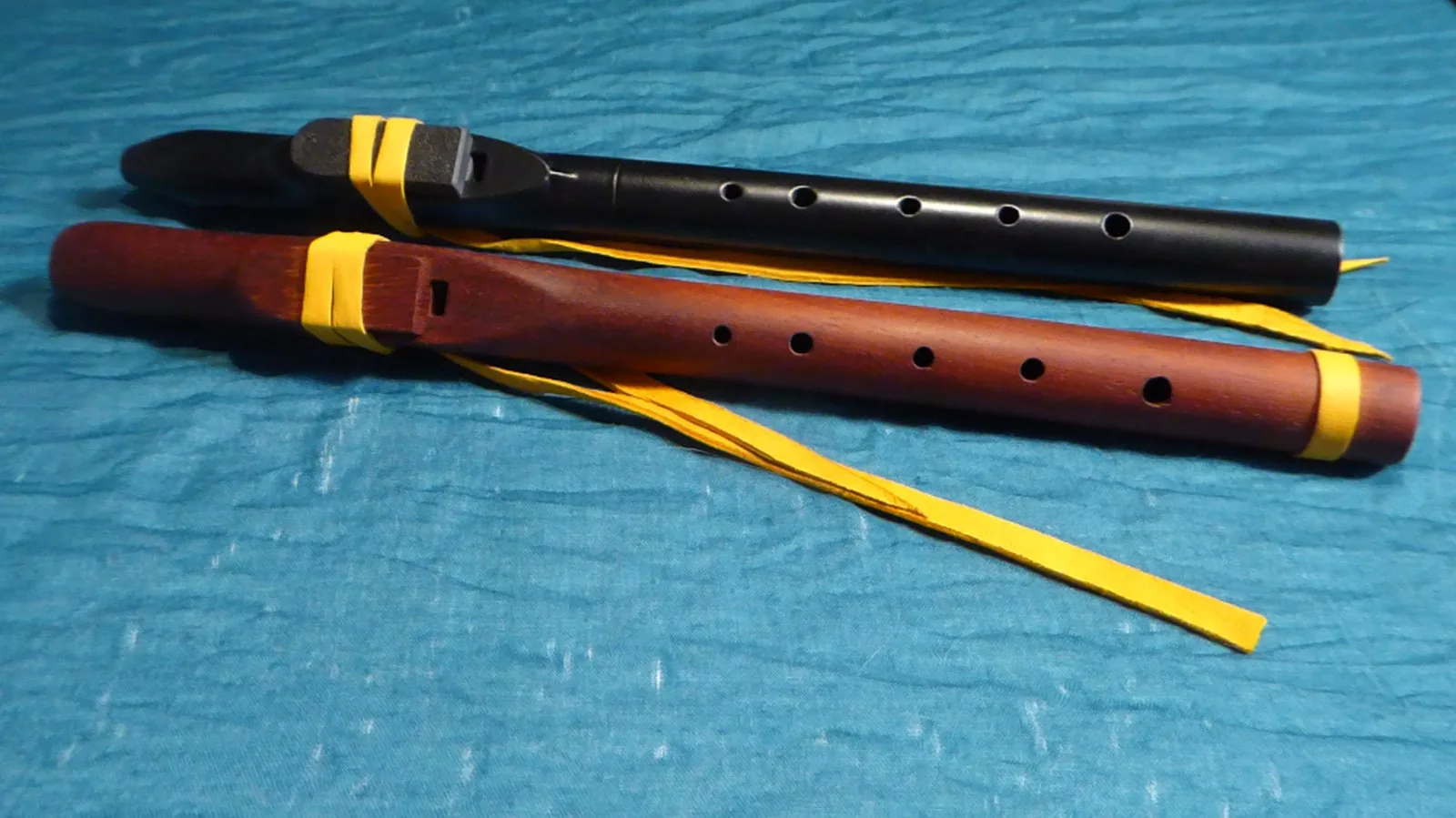
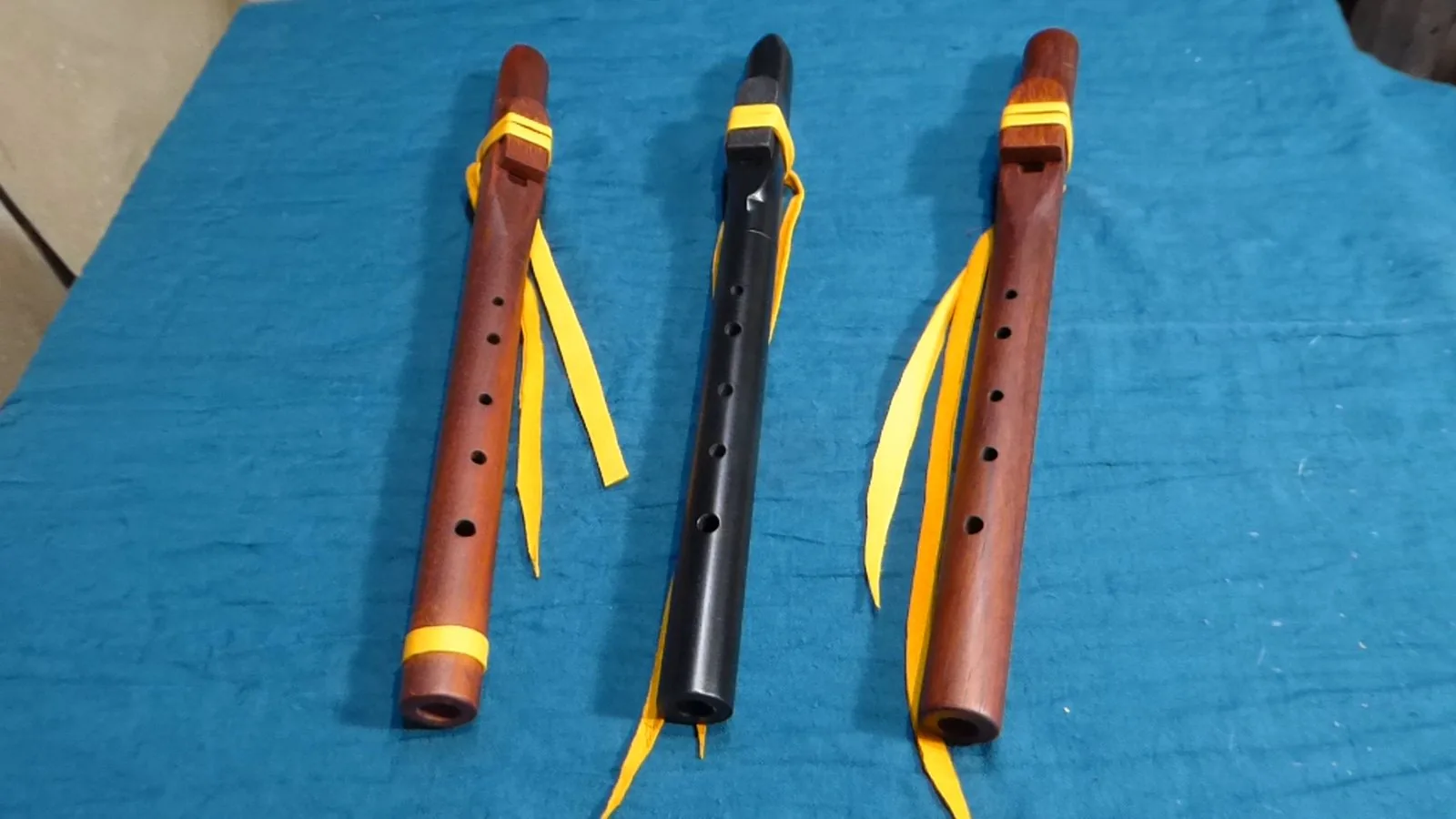
The original. A high Native American flute in E5, made of padauk in our workshop. (Left)
The copy. A 3D-printed copy in PLA, a plastic of plant origin (usually corn starch), made from the measurements of the original. I explain how further down. (Centre)
A third wooden flute, also in E5, used as a control. (Right)

The third flute is there so we have something to compare with. If two wooden flutes were already very different from each other, a difference with the plastic one wouldn’t mean much.
What the theory says
Before telling you what we measured, it helps to know what to expect. What do physics and the people who have studied this say?
In a flute, the air sounds, not the wall
Think first of an acoustic guitar. The strings on their own barely make a sound, because they’re so thin they hardly move any air. Their vibration passes through the bridge to the top, a very thin sheet of wood, and it’s the top that moves a lot of air as it vibrates, so we hear the sound. That’s why wood does matter in a guitar. Depending on how stiff and light it is, and how much the vibration is damped, the top responds one way or another. Its thickness, the bracing inside, and the size and shape of the body also play a part. The same goes for a ukulele. One study compared a PLA-printed ukulele with a wooden one, and the plastic one sounded quieter and with less treble (Niu, 2019).
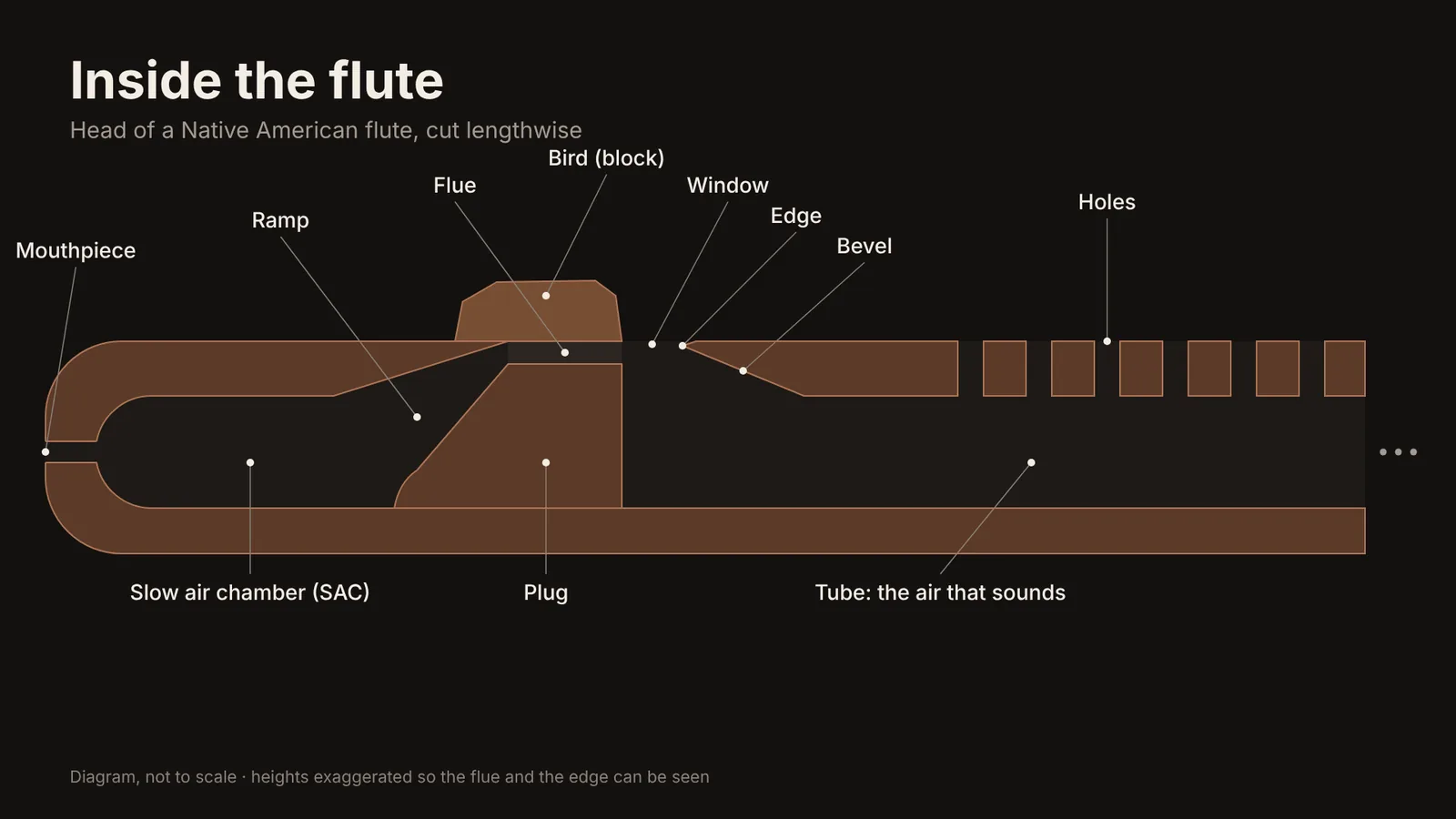
A flute is different. In a Native American flute, the air comes out of a narrow flue and hits the edge of the window, setting the air inside the tube vibrating, and that’s what you hear. The wall, if it’s rigid, hardly vibrates. It doesn’t act as a loudspeaker. It gives the air its shape.

What the research says
This has been studied since the 1960s. Some examples:
John Backus (1964) studied clarinets and concluded that wall vibrations are too small to produce an audible sound.
John Coltman (1971) made three identical flute bodies, in silver, copper and wood, with the same head. The listeners couldn’t tell them apart. They guessed right about one time in three, the same as chance. And the flute players, without seeing which one they were playing, couldn’t either.
Renate Linortner (2001, University of Music and Performing Arts Vienna) compared seven flutes of the same model made in silver, gold of various carats and platinum. The differences in sound were less than half a decibel, and listeners identified the material at most 22 % of the time. On the other hand, there were differences of up to 7 dB from one flute player to another.
Those who have studied it agree that the wall material plays a secondary role in the sound of a wind instrument, and that differences in timbre come mainly from the inner shape.
So this is what we could expect: if the copy had exactly the same shape as the original, almost no difference. With that in mind, let’s go to the test.
How we measured it
So as not to rely only on our ears, we used a program we’re developing to analyse our flutes. It’s still in a testing phase, so before using it we checked that its tuning and acoustic measurements match an independent method and a tuner.
Table 1. How the test was done
| What | How |
|---|---|
| Recording | Zoom H4n Pro recorder, with its built-in microphones, always 30 cm from the flute |
| Conditions | 25 °C and 80 % humidity |
| What was played | The flute’s scale, note by note and without vibrato: E5, G5, A5, B5, D6 and E6 |
| Repetitions | 5 recordings of each flute, alternating the three and warming up each flute for a few seconds beforehand |
| Who played | Me, in every recording |
| Total | 15 recordings and 90 notes analysed |
Why five recordings of each? Because a flute never sounds exactly the same twice. Breath and temperature change. So we set ourselves a rule before looking at the results. A difference between flutes only counts if it’s at least three times larger than how much the same flute changes from one recording to another. It’s a common safety margin when measuring something, so as not to take as real a difference that could come out by chance. It’s like a scale that reads a kilo up or down every time you weigh yourself. If you put on half a kilo, with that scale you can’t tell.
The test was done carefully, but it has its limits. It’s one flute and its copy, played by the same person, on one particular day. And I knew which flute I was playing at each moment. When playing the copy I felt a small difference in the breath, although I couldn’t say exactly what.
Blowing differently also changes the harmonics. The sound is born when the jet of air coming out of the flue moves up and down across the edge, going in and out of the flute. If you blow harder, the jet goes faster, the sound comes out brighter and the note goes up a little. And if the jet isn’t aimed exactly at the centre of the edge, because you slightly change the angle of your lips or of the flute, it’s mainly the even harmonics that change. So we can’t rule out that part of the difference comes from how I blew each flute.
A few concepts to understand this
The note. When you play a note, the air inside the flute vibrates a fixed number of times per second. The G5 of this flute is designed to sound at 783.7 hertz (Hz), meaning the air vibrates 783.7 times per second. That main vibration is what we hear as the note. Technically it’s called the fundamental.
The harmonics. The air doesn’t vibrate only at that speed. At the same time it also vibrates at double, triple, quadruple… In the G5, at about 1567, 2351 and 3135 Hz. We don’t hear them as separate notes. They blend with the main one and give it its colour.
A helpful analogy is cooking. The note would be the main ingredient and the harmonics, the spices. With the same ingredient and a different mix of spices, the dish tastes different. Something similar happens with sound, and that’s why a flute and a violin don’t sound the same even when they play the same note. That colour is called timbre, and it depends largely on the weight of each harmonic (the breath noise and how the note starts also play a part).
A drum works differently. Its skin also vibrates at several frequencies at once, but they don’t follow those exact multiples, and that’s why it sounds less like a note and more like a beat. We talk about it, with measurements of our drums, in Possible benefits of the shamanic drum: what we know and what we don’t.
What each harmonic adds
Each harmonic is really another note sounding at the same time, very softly, on top of the main one. With the G5 of this flute:
Table 2. The harmonics of G5 (design frequencies)
| Harmonic | Frequency | Which note it would be | What it adds |
|---|---|---|---|
| The note (1st) | 783.7 Hz | G5 | The pitch. It’s what we hear as the note. |
| 2nd | 1567 Hz | G6, one octave higher | It’s the same note higher up, so it blends almost completely with the main one. It doesn’t change its character; it makes it fuller and somewhat brighter. |
| 3rd | 2351 Hz | D7, an octave and a fifth above | The first different note to appear. It has a lot to do with the character of the instrument. The clarinet, in its low notes, has a strong 3rd and a very weak 2nd, which is why its sound is often described as hollow. |
| 4th | 3135 Hz | G7, two octaves higher | The same note again, even higher. It adds brightness without changing the character. |
| 5th | 3918 Hz | B7, two octaves and a third above | Another different note, already very high. |
| 6th and above | over 4700 Hz | — | In a flute they’re very weak. They mainly add brightness. |
The even harmonics (2nd, 4th…) are the same note in higher octaves. The odd ones (3rd, 5th…) are different notes. This is important for understanding the results.
In a flute like this one they all sound, but each one softer than the last. In our flutes, depending on the note, the 2nd is between 5 and 35 dB below the note, and the 4th and 5th between 14 and 51 dB below. The more weight the harmonics have compared with the note, the brighter the flute sounds. The more the note alone dominates, the softer and rounder. Neither is better than the other.
Decibels (dB). They measure how much louder one sound is than another. They don’t work like an ordinary ruler but in leaps: each time you add decibels, the energy is multiplied. 10 dB more is ten times the energy, 20 dB more is a hundred times (10 × 10) and 30 dB more, a thousand times. Halfway, about 3 dB more is double the energy, and about 6 dB more, a vibration twice as wide. It’s measured this way because the ear works this way too. We hear everything from a whisper to a painfully loud noise, with a trillion times more energy between one and the other, and we don’t notice how much more something sounds, but in what proportion. With this, the figures in the article are easier to understand. A 2nd harmonic 22 dB below the note has about 160 times less energy. And if it sounds 7 dB louder in the copy, it has about five times more energy than in the original. Even so, it’s still very soft next to the note.
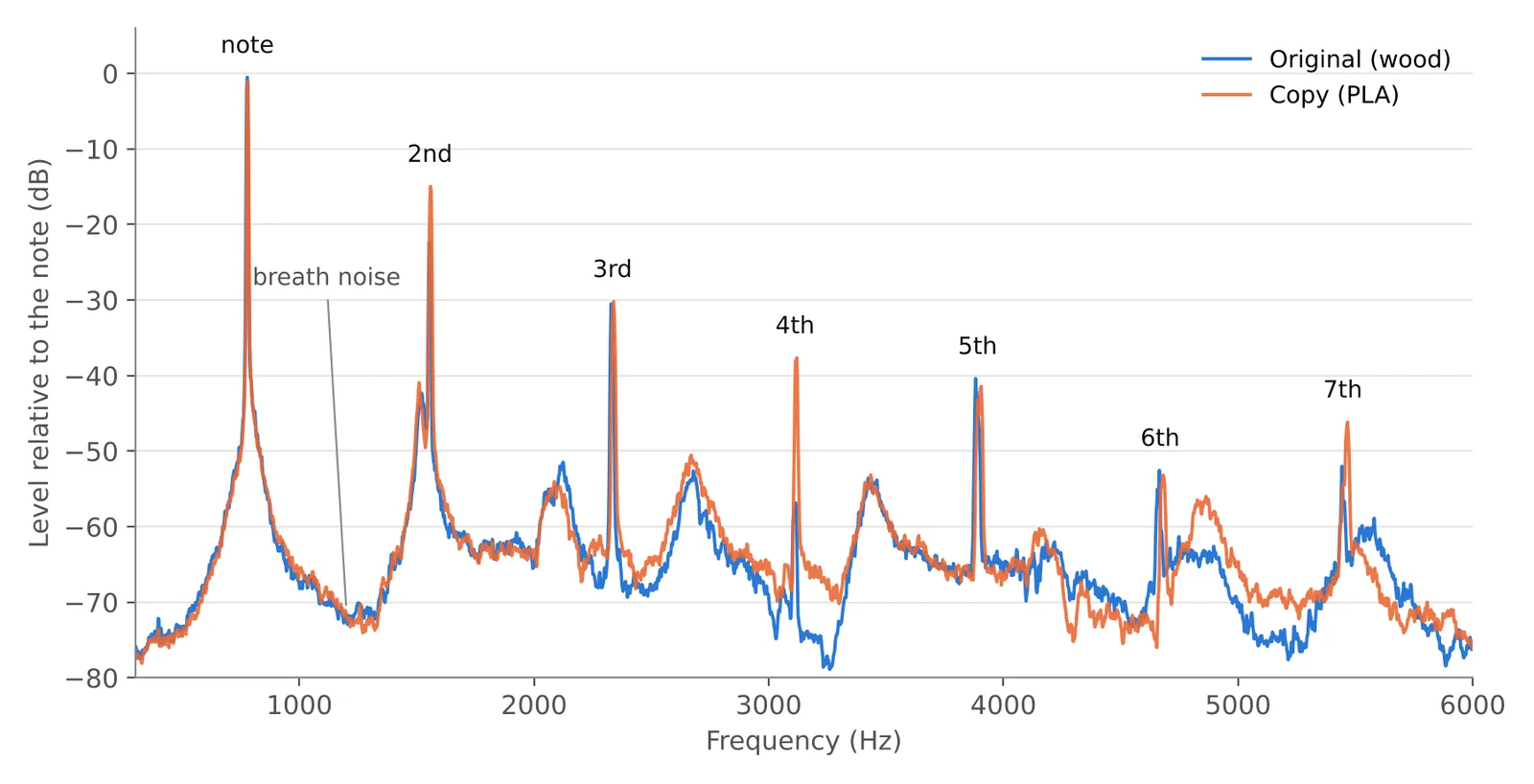
The spectrum. It’s a graph that lets you see sound. From left to right it goes from low to high, and upwards it shows how much each frequency sounds. The peaks are the note and its harmonics. The part below, between the peaks, is the breath noise, that hiss every flute has.
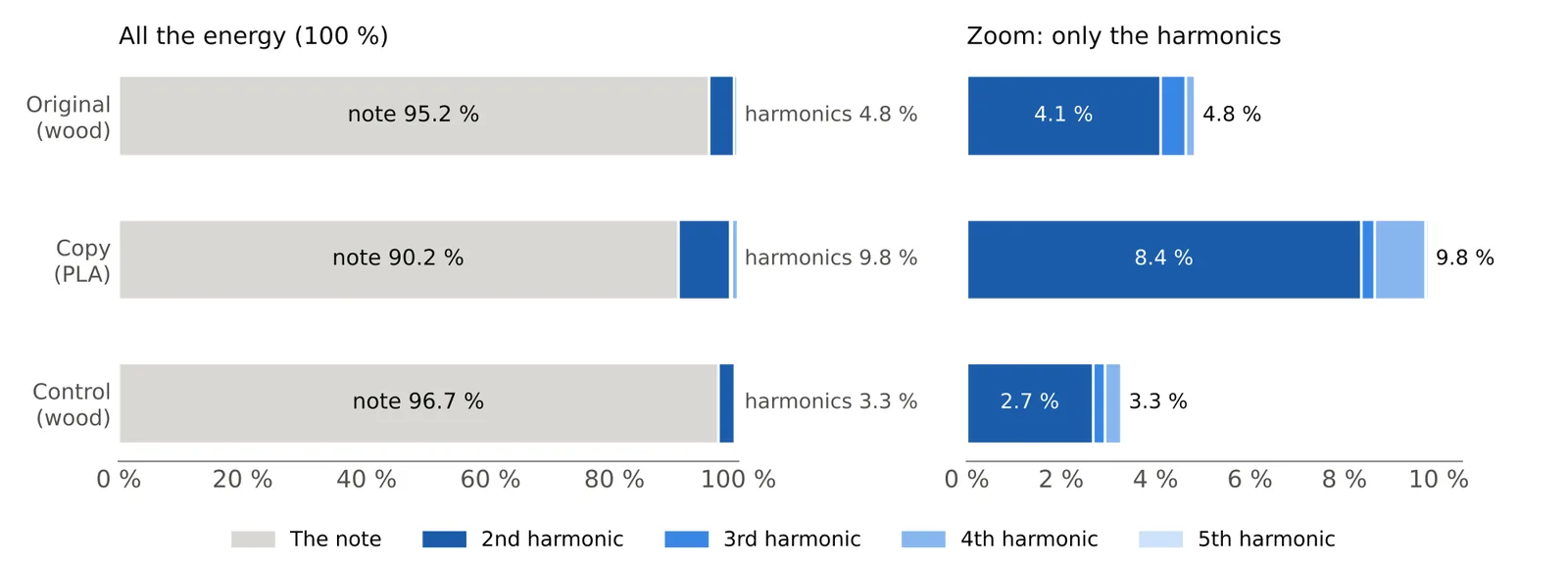
How much of the energy the note takes. Imagine you put together all the energy of the note and its 2nd, 3rd, 4th and 5th harmonics, as if it were a cake. This measure tells you which slice of the cake belongs to the note and how much is left for the harmonics. In a flute the note takes almost everything, because the harmonics are much softer. In the low notes of the original, the note takes 95 % and the harmonics share the remaining 5 %. In the copy, the note takes 90 % and the harmonics get 10 %. In other words, in the copy the harmonics have twice the weight, although the note still dominates. The smaller the note’s slice, the brighter the flute sounds.

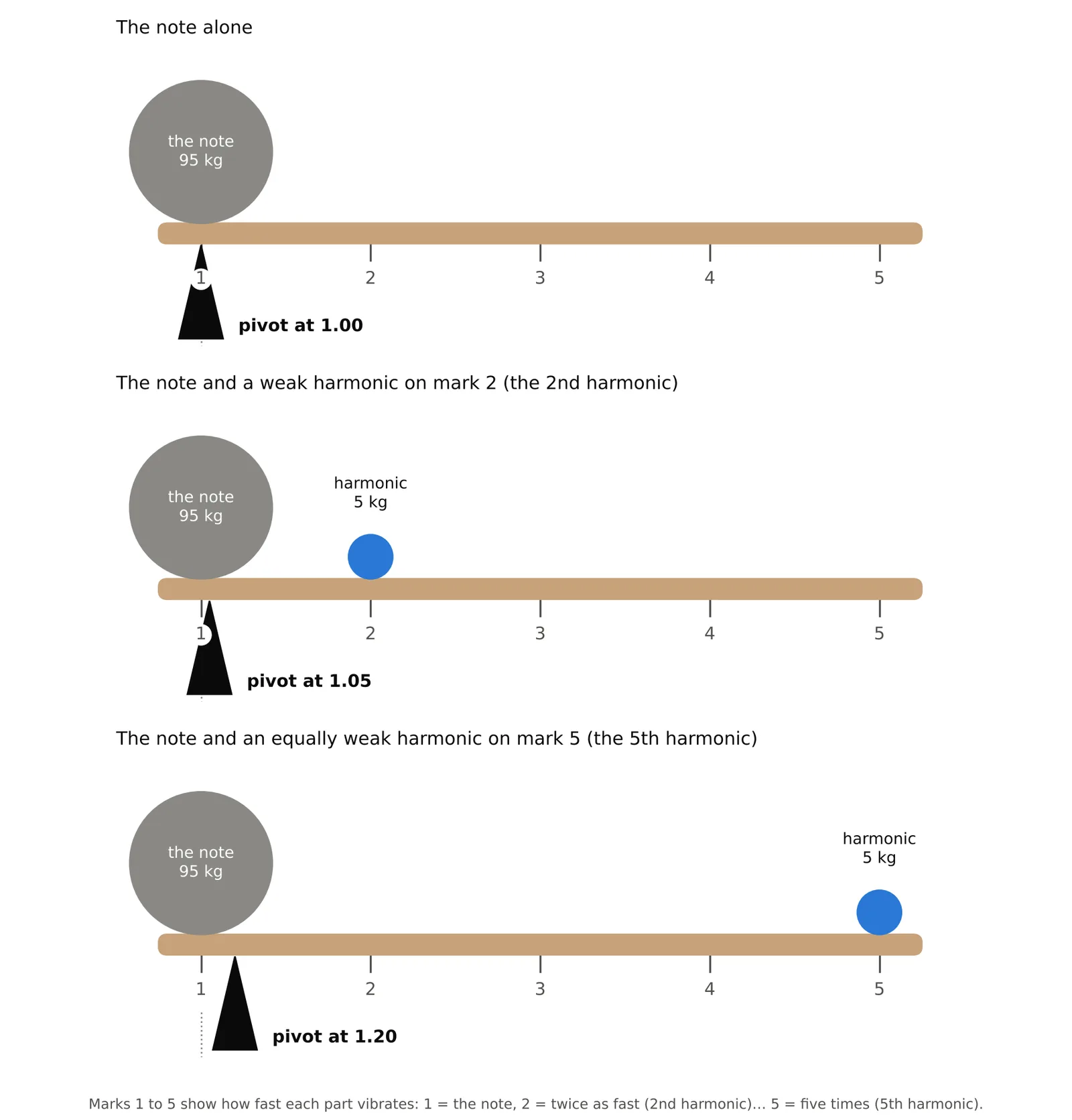
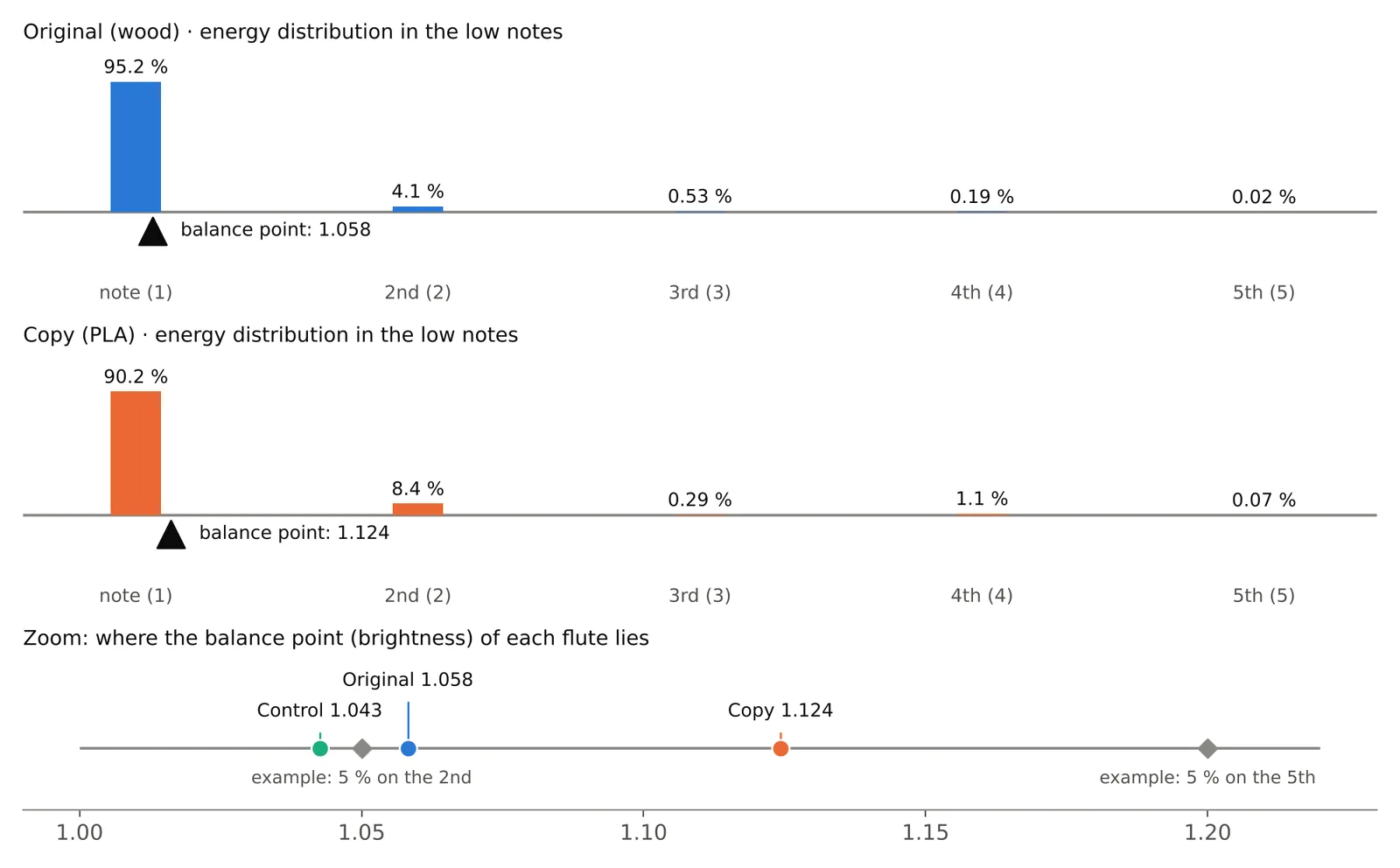
Brightness. With the same cake, brightness tells us where the weight of the sound lies. It would be like the balance point of a seesaw. But now it also matters how high each harmonic is. Imagine the plank of a playground seesaw, long, with five marks at equal distances, numbered 1 to 5. Each number tells you how fast each part of the sound vibrates. The note goes on mark 1; the 2nd harmonic, which vibrates twice as fast, on mark 2; the 3rd, which vibrates three times as fast, on mark 3, and so on up to the 5th. The further the mark, the higher that harmonic. Now sit someone on each mark who weighs as much as their slice of cake. The note is a big adult, sitting on mark 1. The harmonics are small children, spread over the other marks. Brightness is the point where you’d have to put the pivot of the seesaw for the plank to balance. If only the adult were there, the pivot would go right under them, at 1. The heavier the children, and the further away they sit, the more the pivot has to move towards them. For example, if the note weighs 95 kilos and a 5-kilo baby sits on mark 2, the pivot goes at 1.05. If the same baby sits on mark 5, the pivot has to move all the way to 1.20. In the low notes, the original gives 1.058 and the copy 1.124: in the copy the pivot moves a little further, because its harmonics weigh more.
The note’s share tells you how much energy the harmonics take. Brightness also tells you how high those harmonics are. That’s why it’s the measure that best sums up whether a flute sounds brighter. Its technical name is harmonic centroid. Careful, because it’s not the spectral centroid, the more commonly used one, which is given in hertz. That one depends on how high the note is and is affected by the breath noise, so to compare flutes note by note we use the harmonic one.


What we found
A close look at G5
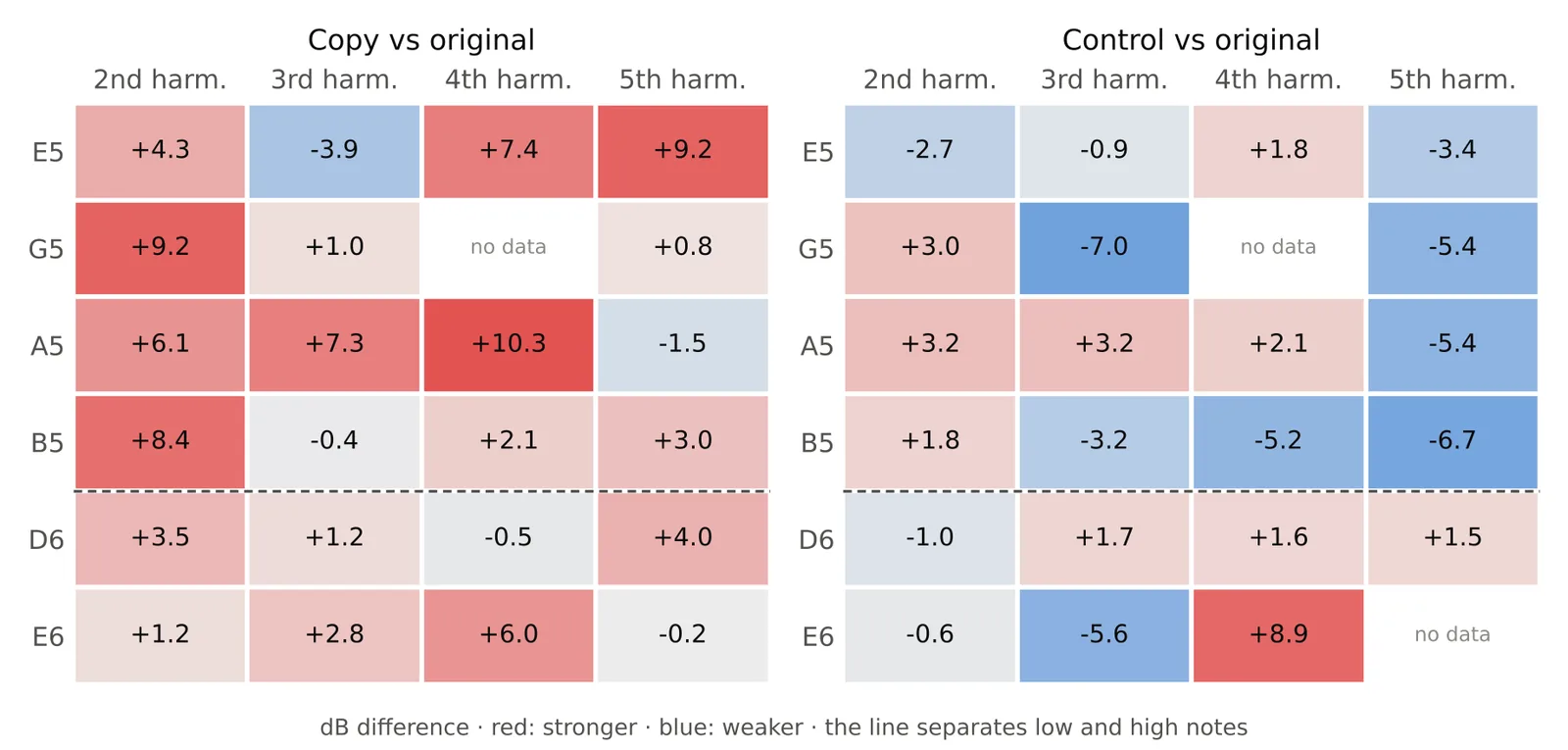
To see the difference up close we chose G5, the note you get by uncovering the first hole. It’s the note where the 2nd harmonic changes most (9.2 dB louder in the copy; in the other low notes, between 4.3 and 8.4 dB), and it’s the same one we show in the video. The 4th harmonic also changes, but in the original’s G5 it’s so weak that the program couldn’t measure it. Where you can best see both at once is in A5: the 2nd rises 6.1 dB and the 4th, 10.3 dB (Figure 6).

In G5 it’s very clear. The note and the 3rd, 5th and 6th harmonics are practically at the same height in both flutes, and the breath noise, the lower part, runs almost level. What changes is two peaks. The 2nd harmonic is quite a bit stronger in the copy, and the 4th, which in the original barely rises above the breath noise, stands out clearly in the copy. In the original the program couldn’t separate the 4th harmonic from the breath noise in any of the five recordings, so we can’t say exactly how many decibels apart they are in that note. Above the 5th harmonic the program doesn’t measure. In the graph the 7th also comes out somewhat higher in the copy, but we haven’t analysed it.
All the harmonics, in every note
A spectrum is one note on one flute. To see whether the difference is general you have to look at everything. We measured the 2nd, 3rd, 4th and 5th harmonics in the six notes of the scale, in the five recordings of each flute.

The figure is easiest to read by comparing the two sides.
The 2nd harmonic comes out stronger in the copy in all six notes, and much stronger in the four low ones (between 4.3 and 9.2 dB).
The 4th also comes out stronger in the copy in E5 and A5, the two low notes where it could be measured in every recording (7.4 and 10.3 dB).
The 3rd and 5th go up in some notes and down in others, with no clear pattern.
Between the two wooden flutes (right) the same happens with all the harmonics. They go up and down with no pattern, sometimes by quite a lot (up to 7 or 9 dB in some notes).
That last point matters. If between two wooden flutes that sound the same there are differences of 7 dB in a single note, a single note proves nothing. What counts is a difference that repeats, note after note and recording after recording.
To know whether these differences are real, and not chance, we applied the three-times rule by grouping notes. The difference in brightness holds however we group the notes, except when looking only at the two high ones, where no measure passes the rule. Note: we decided to split the notes into low and high after seeing the data. All the details are in the drop-down «How we checked that the difference is real», at the end of the article.
What the results mean
From firmest to least firm:
The copy sounds brighter, especially in the low notes. It’s the clearest result (5.0 in the low notes and 3.5 even with all six notes together), because brightness sums up all the harmonics at once.
That brightness comes from the even harmonics. The 2nd is 7.0 dB louder on average and the 4th, 8.9 dB. As both are the same note in higher octaves, the change is subtle. The copy doesn’t sound like another instrument, but like the same flute with a bit more brightness in the low notes.
As the even harmonics take more energy, the note is left with a little less. In the copy it takes 90 % of the energy, compared with 95 % in the original. It’s the same thing seen from the note’s side.
The odd harmonics (3rd and 5th) don’t change.
In the high notes nothing can be said. The copy comes out somewhat higher in several measures, but there each flute changes a lot from one recording to another and no difference passes the rule. There may be a small difference or there may not. With these measurements we don’t know.
The amount of breath noise is the same in both. The program’s measure doesn’t pass the rule, either way. But that doesn’t mean they sound equally breathy, as I explain just below.
The two wooden flutes can’t be told apart in anything. No measure passes the rule between them. So the copy’s difference is real, larger than the one between two wooden flutes.
So why does the wooden one seem breathier? It does to me, and in the comments on the Reel several people said the same. The amount of breath noise is the same, but not what surrounds it. In the G5 spectrum (Figure 5), the breath noise of both flutes is at the same height. What changes is what rises above it. Around 3000 Hz, the copy’s 4th harmonic stands about 21 dB above the breath noise. The original’s barely rises 2 dB and is almost buried. And that range is exactly where the ear is most sensitive. So in the original, in that range, what you hear most is the hiss of the breath, and in the copy the harmonic partly covers it. We believe that’s why the wooden one can sound breathier without having more breath noise. It’s an explanation that fits the measurements, but we haven’t tested it with a proper blind listening test.
Careful: a louder harmonic doesn’t mean the flute sounds louder. The note is the same. What changes is the proportion of one of the harmonics, not the volume.
What this doesn’t say. It doesn’t say that one sounds better than the other. The data say they sound different. Nor does it say whether that difference can be heard, because that would take a proper blind listening test, and we haven’t done one.
What would it take to say that one flute is better than another? Better isn’t in the sound; it needs a criterion. More harmonics isn’t better or worse, it’s brighter, and some people prefer a bright sound and others a warm one. To be able to say better, you’d need one of these two things.
That it works better at something almost everyone agrees on. For example, that its notes are in tune with each other, that the note doesn’t break or jump an octave with normal breath, that it takes more variation in breath without going out of tune, that the notes start cleanly or that it has no weak note. Even then, it would be better at that, not a better flute.
That most people like it more in a blind listening test. Many people who don’t know which is which, several rounds and in different orders. If one is clearly preferred more often than chance would give, you could say that group liked it more. It would still be a preference.
Our test measured timbre, and timbre only tells you whether two flutes sound different. That’s why we don’t say one is better.
So, is it the plastic?
The easy answer would be yes. But we can’t claim that, and here’s why.
A copy is never identical
So why does our copy sound different? Most likely because it isn’t exactly the same. Even less so with our means, because neither the original nor the copy is an industrial precision part. Differences of tenths of a millimetre in the edge, the flue, the holes or the bore change the weight of the harmonics.
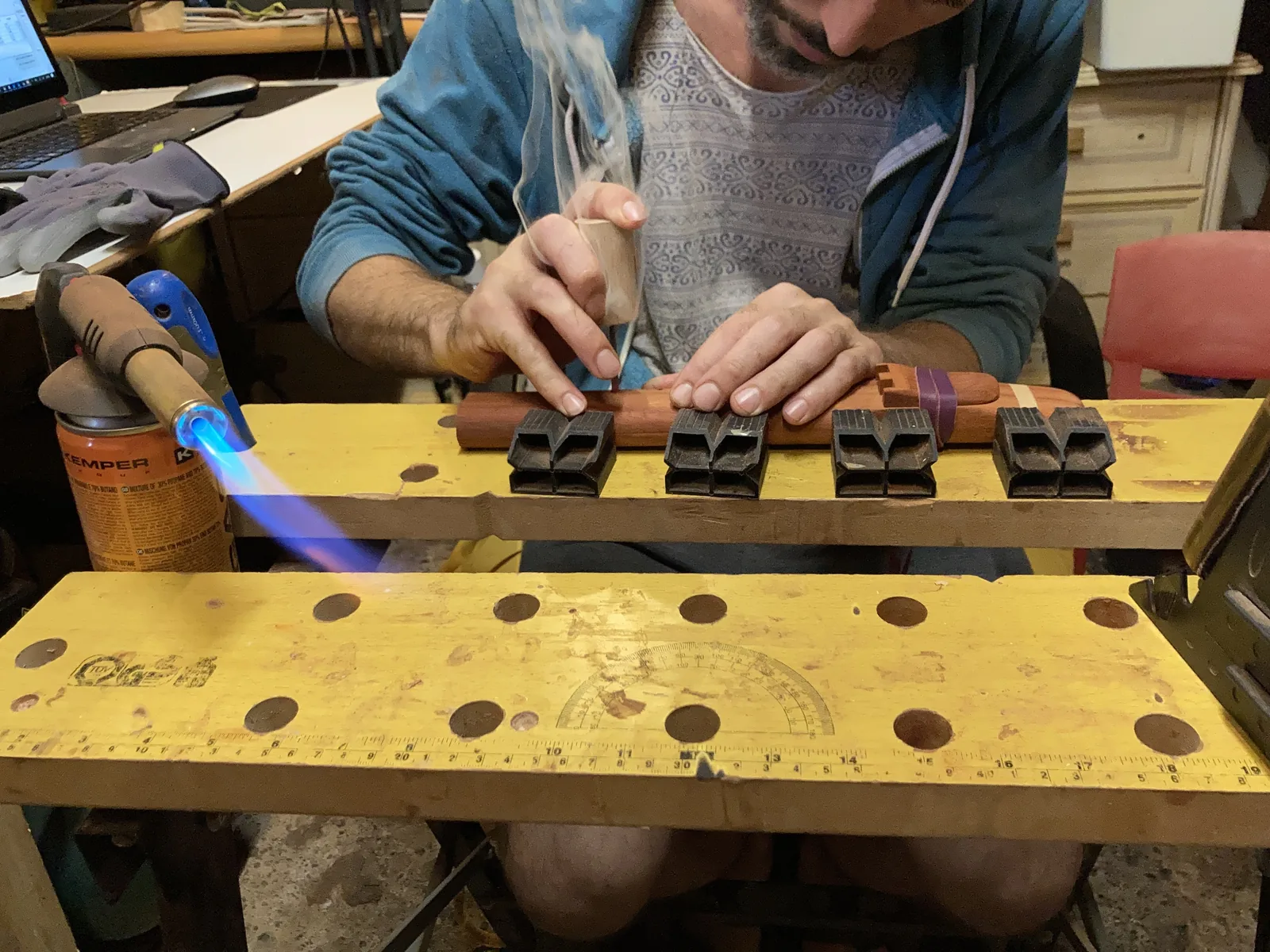
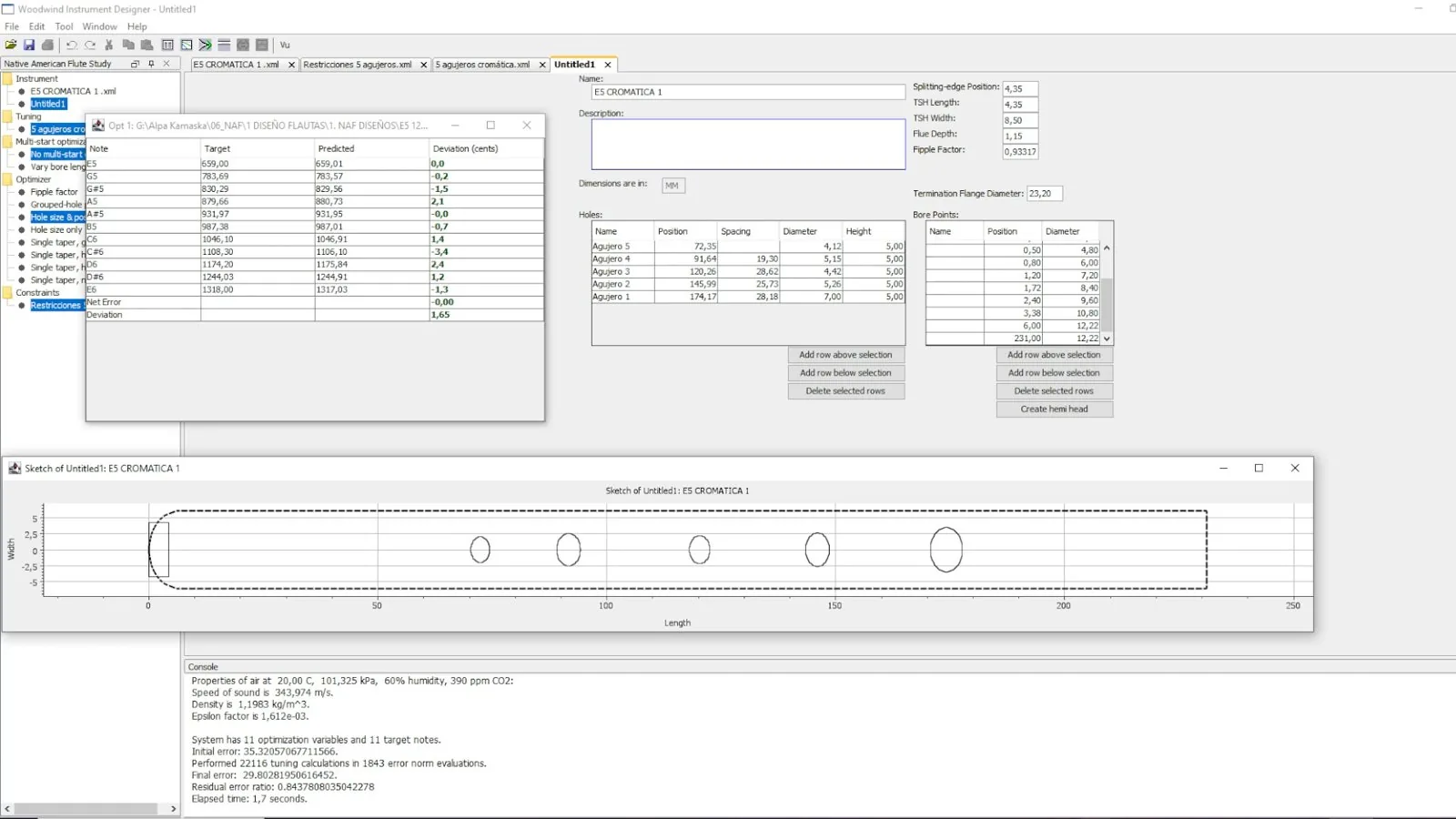
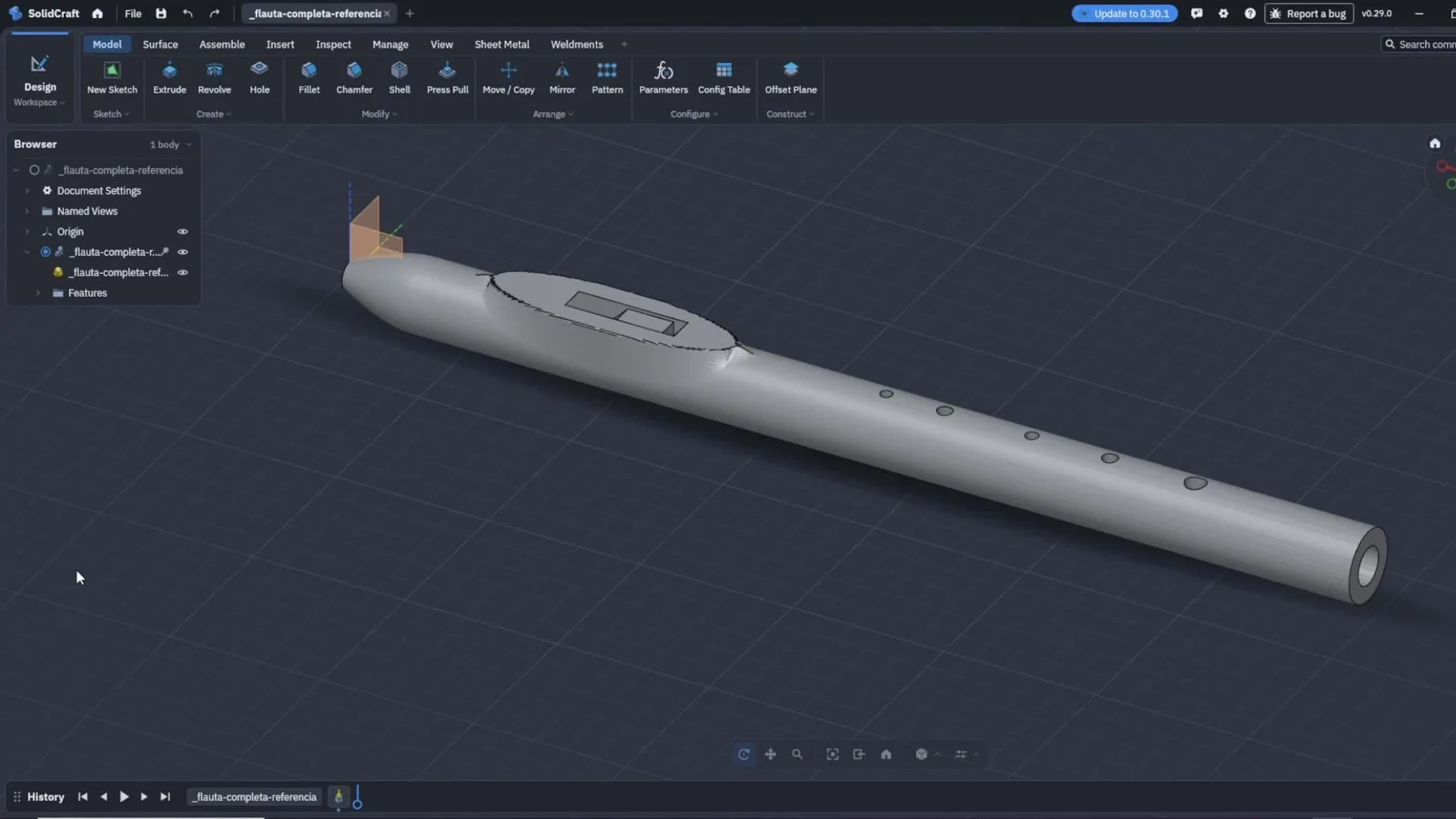
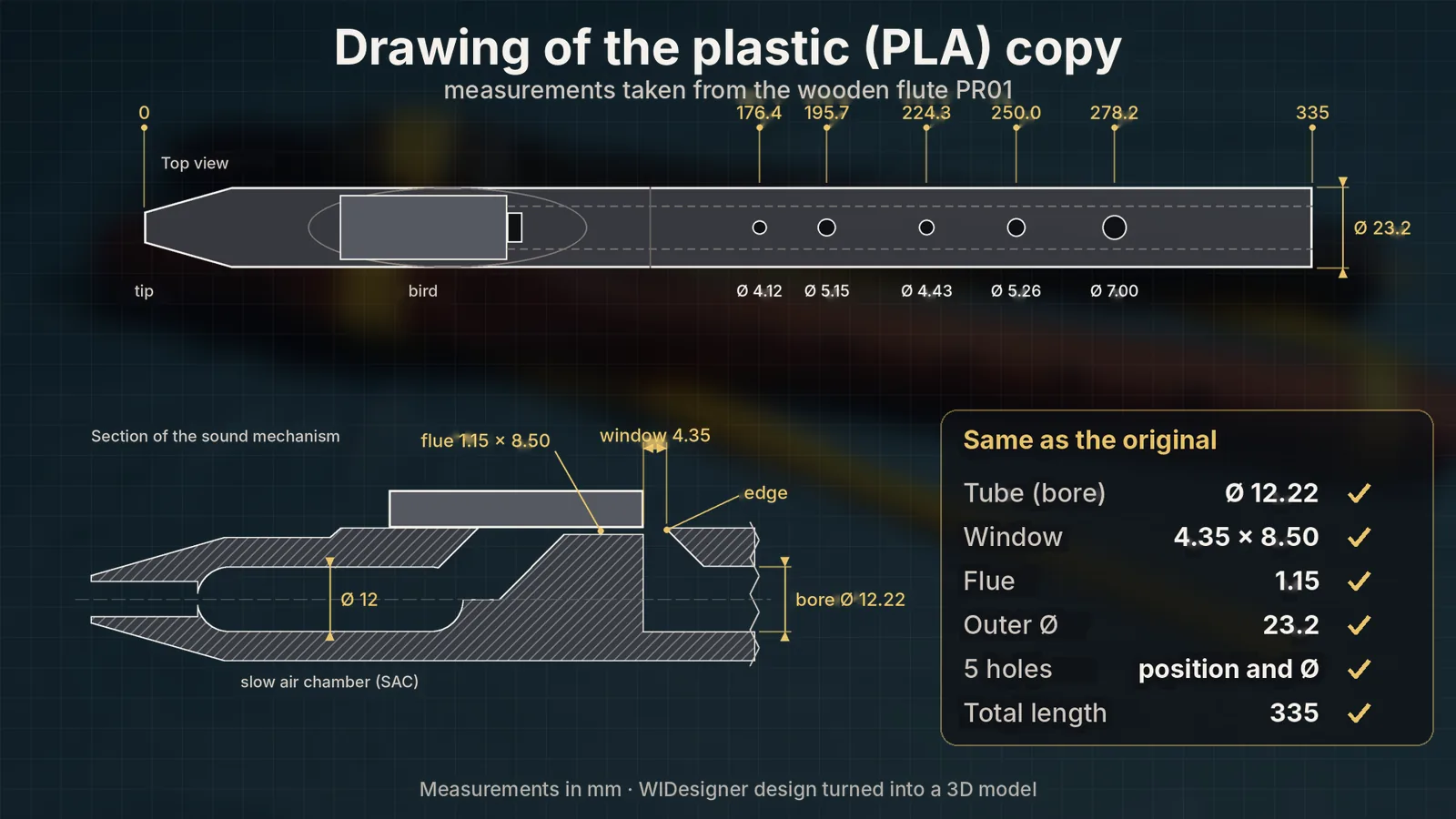
This is how we made the copy. We started from the design of the wooden flute in WIDesigner, a free wind instrument design program developed by Edward Kort, with the measurements of the finished flute (the bore, the holes, the flue and the window). Then we turned it into a 3D model, and from there came the print file.


Figure 7. On the left, the design of the original flute in WIDesigner. On the right, the 3D model of the copy.

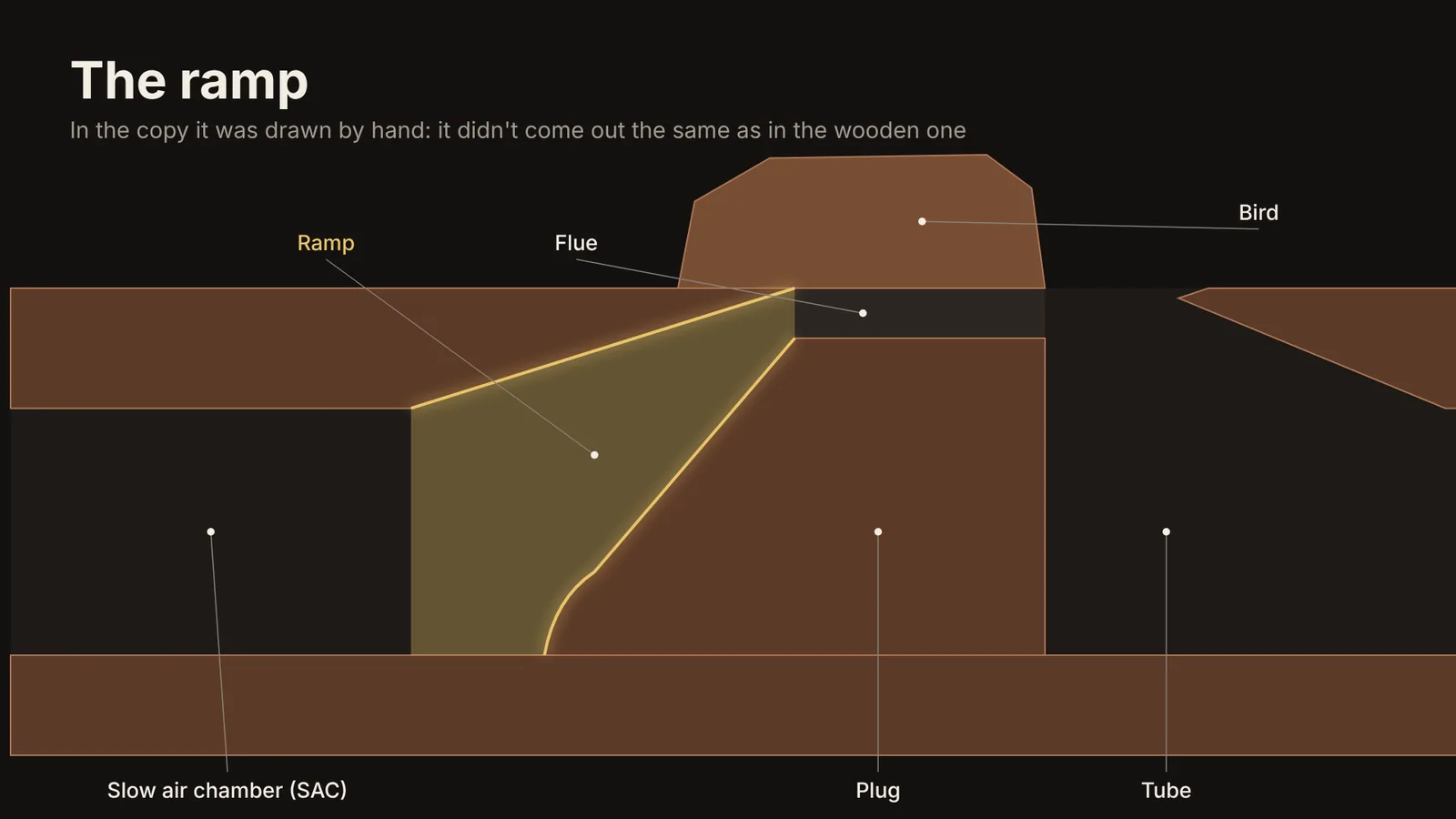
WIDesigner calculates the tube and the holes, but not the whole shape of the area where the sound is born, and we drew that part by hand. We know there’s at least one difference. The copy’s ramp doesn’t have the same shape as the wooden flute’s.

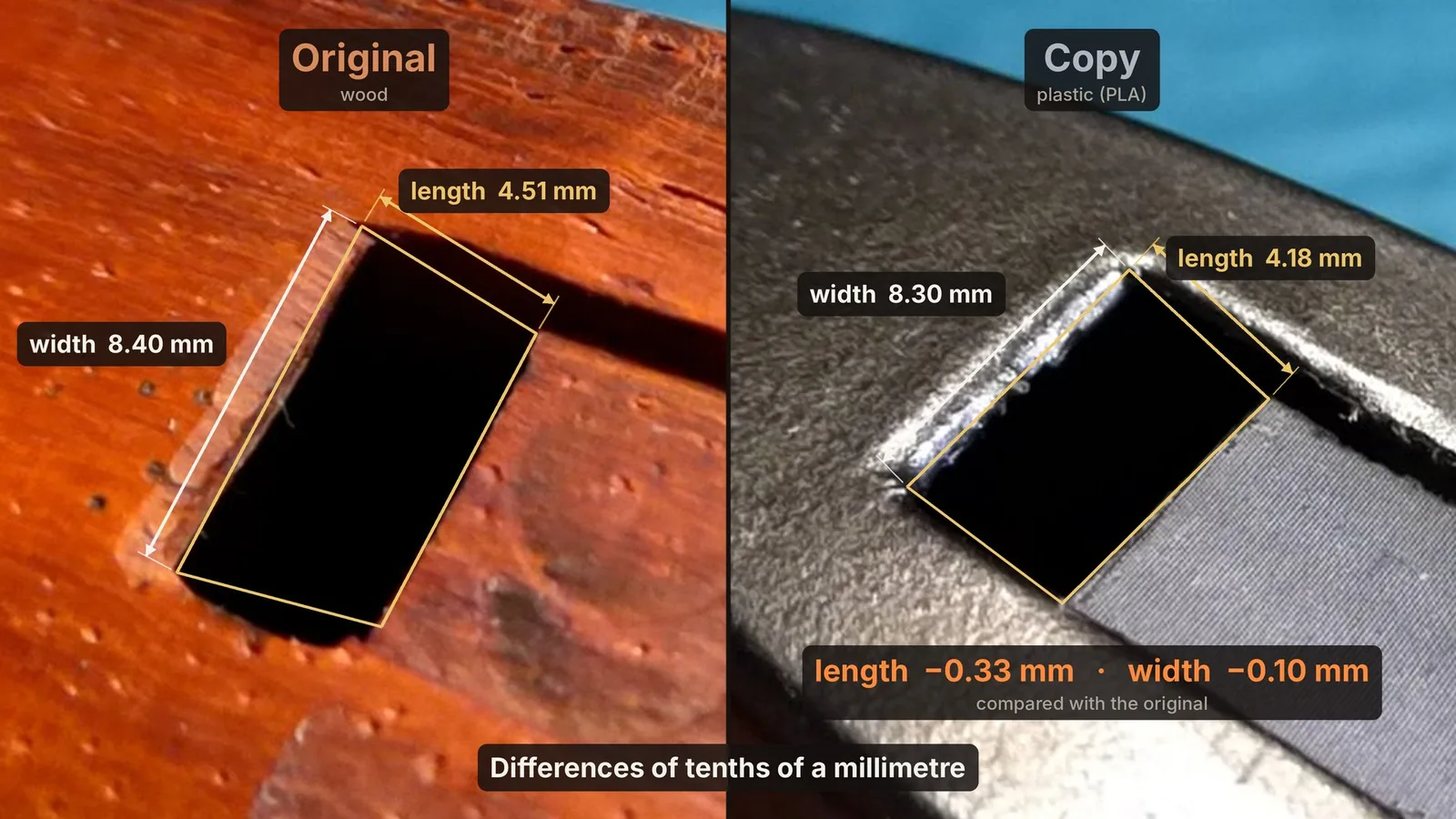
Then we measured the window and the flue of the original and the copy with a caliper.
Table 3. Measurements of the area where the sound is born
| Measurement | Original (wood) | Copy (plastic) | Control (wood) |
|---|---|---|---|
| Window length | 4.51 mm | 4.18 mm | 5.16 mm |
| Window width | 8.40 mm | 8.30 mm | 9.58 mm |
| Flue depth | 1.18 mm | 1.21 mm | 1.29 mm |
The original and the copy, measured with the same caliper, to within one or two tenths of a millimetre. The control flute, measurements from its WIDesigner design.

The copy’s window is 0.33 mm shorter and almost as wide, and the flue is practically the same. But the control flute’s window is more than half a millimetre longer than the original’s, and those two sound the same. So the window doesn’t seem to be the explanation.
Also, a 3D printer works in layers, with its own precision, and leaves its own finish inside. All of that has to do with how the copy was made, not with what it’s made of. Even wooden replicas of old flutes, made with the utmost care, sound different from the original in their harmonics (2026 review on replicas of historical instruments).
There’s one more detail pointing the same way. The difference we measured in the even harmonics (7 to 9 dB) is far larger than the half decibel Linortner found when changing only the material in flutes made with industrial precision. That’s why we think the shape matters more here than the plastic.
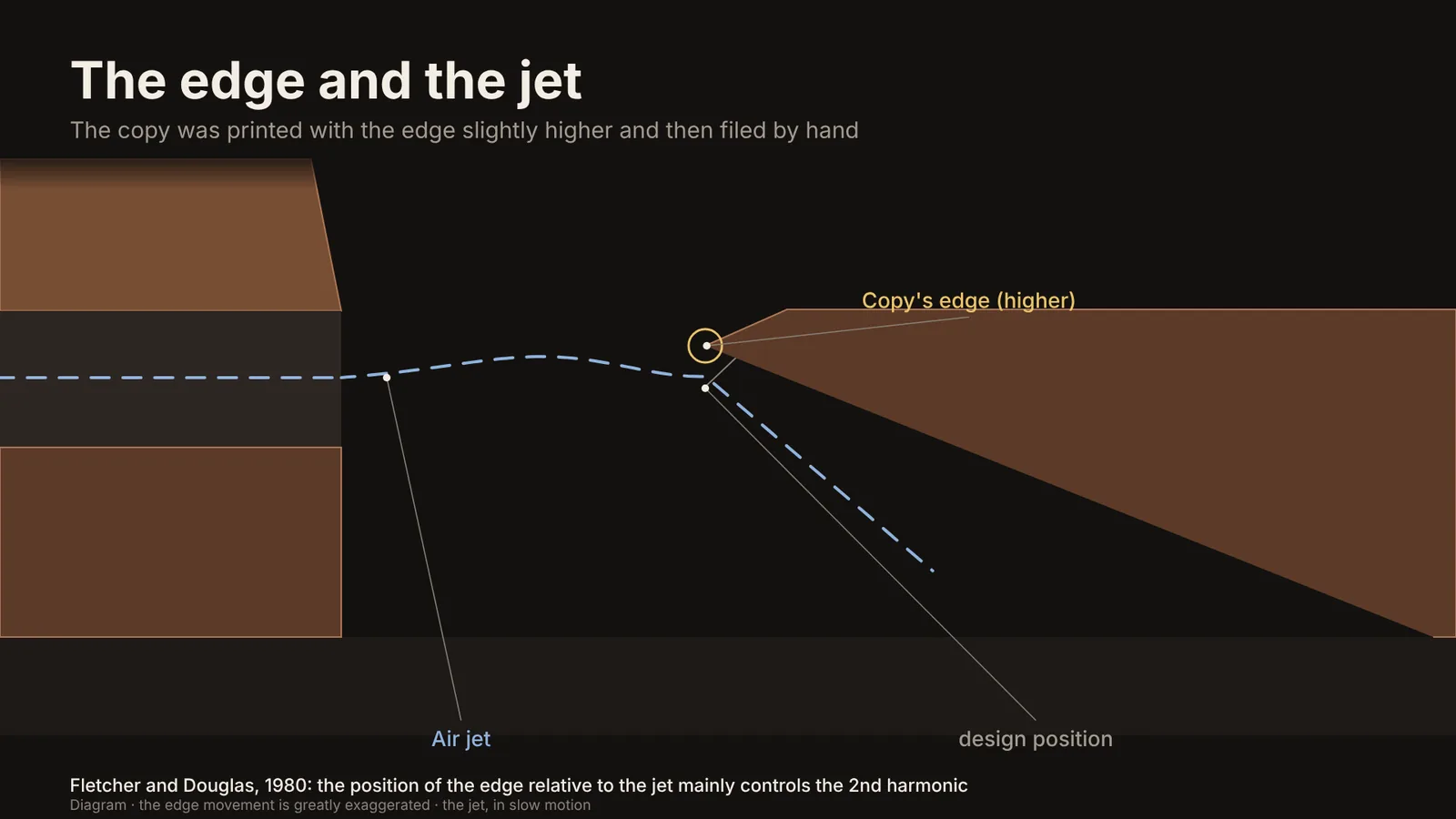
The clearest clue: the edge
There’s something else we do know. We printed the copy with the edge a tiny bit higher (about three tenths of a millimetre), on purpose, so we could adjust it later by hand. When filing it to remove the burrs and redo the bevel, I can’t know exactly where it ended up. And the position of the edge relative to the air jet is precisely what most affects the even harmonics. Fletcher and Douglas studied it in organ pipes, recorders and other flutes, and found that the strength of the even harmonics, especially the 2nd, depends a lot on how centred the edge is relative to the jet. With the edge well centred, the 2nd harmonic drops a lot (Fletcher and Douglas, 1980).
In our copy it was precisely the even harmonics, the 2nd and the 4th, that went up, while the odd ones stayed the same. I can’t be sure it’s the edge, but it points much more to the shape than to the plastic.

What we still don’t know
Of everything we’ve seen, the height of the edge is the clue that interests us most. Fletcher and Douglas studied it in organ pipes, recorders and flutes, and in our copy exactly what they describe changed: the even harmonics. What we can’t do is measure precisely where the edge ended up after filing. Comparing the two flutes by eye, it most likely isn’t in the same position as in the original. But we don’t know how much it moved or in which direction, and to know that we’d have to measure tenths of a millimetre. So for now it’s a clue, not proof.
We’d like to look into this further, because understanding it would also help us build better wooden flutes. We’ll try to do so in future articles.
What the listener hears and what the player feels
That’s the data. Now my opinion, which is only that. To me the wooden one sounds better, more organic. But the data don’t say it sounds better; they say it sounds different. I also think it’s important to separate what you hear from what you feel when you play it. When I play the wooden one I feel how it responds to the breath, the touch, the weight, and a warmth that draws me to it more. A microphone doesn’t measure that.

There’s a recent study that fits quite well with this, and that also invites caution. In 2025, a team of researchers compared a wooden baroque flute with two 3D-printed resin copies, made from an X-ray scan of the original (Fritz et al., 2025, Music & Science).
69 people listened to recordings of the flutes without knowing which was which, and couldn’t tell them apart beyond chance.
Nine professional flute players played them. They described the wooden one as richer and warmer. They found the printed copy very uniform and too easy, and one said it was like playing a copy of a copy.
The players couldn’t play blind, because they could feel the material on their lips and fingers. And when, without telling them, they were given the same printed copy again, they described it more favourably, even as warm and nuanced. The authors themselves wonder whether the preference for wood might partly come from the prior idea that wood is richer than plastic.
What the player feels is real. The touch, the weight, the temperature and the way an instrument responds change how you play, and that ends up showing in what the player conveys. But what we know, or think we know, about an instrument also influences how we feel it. It happens to me too. And since we haven’t done a proper blind listening test, we don’t know whether someone listening to our two flutes without seeing them would tell them apart.
A parallel with the electric guitar
In the electric guitar world there’s a similar debate that never ends. Does the body wood matter? Do the pickups matter more? Does an old guitar worth a fortune really sound better than a well-made one today? There’s no agreement, and everyone has their preferences.
There’s an idea I’ve heard on guitarists’ channels that seems very sensible to me. If an instrument makes you feel it differently, and that makes you play more happily, for longer or more connected to it, it’s worth it, even if a microphone finds no difference. I think something very similar happens with flutes. And it’s the same thing Renate Linortner pointed out at the end of her study: a musician’s preference for an instrument may have more to do with how easily they can get the sound they have in their head than with the material.
Wood or plastic: the advantages of each
If the material matters little for the sound, why do some people pay quite a lot more for a flute made of a special wood? I don’t think it’s all suggestion. The touch, the weight, the beauty of the wood and the work of whoever made it are real. And plastic, depending on what you want it for, can be the better option.
Advantages of a wooden flute
Each piece is unique, because of the grain, colour and smell of the wood, and because of the handwork.
Touch and temperature. Wood warms up in your hands and is pleasant to the touch.
It ages with whoever plays it. Over the years it takes on a patina and becomes more yours.
The relationship with the instrument: knowing who made it, which tree it comes from and how it was built.
It withstands heat without warping.
Advantages of a 3D-printed plastic flute
It’s usually cheaper.
It doesn’t crack with humidity or changes in climate, and it doesn’t need oils.
It washes easily with soap and water, so it’s practical for sharing in workshops, schools or groups.
You can take it to the beach, hiking or travelling with more peace of mind.
For a maker it’s a great tool, because it lets you test designs and repeat the same flute very precisely.
What to know about each
Wood needs to dry well after playing and doesn’t like sudden changes in humidity. We talk about it in Native American flute care.
PLA softens from about 55–60 °C, so never leave it in the sun inside a car or near a heat source.
The best flute is the one you feel like picking up and playing. If you can, listen to it and play it first. And if you’d like more ideas for choosing, there’s our guide How to choose a Native American flute.
The weak points of this test
I want to be clear about this. This is a workshop test, done carefully and with a rule set before looking at the data, but it isn’t a scientific study. We’re aware of its weak points, and these are the main ones.
A single flute and a single copy. With one flute of each material nothing can be said about wood or plastic in general. Another copy, or another wooden flute, could give a different result.
It doesn’t separate material from shape. As the copy isn’t identical to the original, the test can’t fully answer whether it’s the material. For that you’d need flutes with exactly the same shape in different materials, or several copies in the same material to see how much they vary among themselves.
A single player, who knew which flute he was playing. I played all the recordings, seeing each flute. My breath may have changed from one flute to another without my noticing, and breath changes the harmonics. A real study uses an artificial mouth, which always blows the same, or several players who don’t know which flute they’re playing.
Few recordings and a single day. Five recordings per flute, in a single session, with that day’s temperature and humidity.
We decided to split low and high notes after seeing the data. That can make a difference look clearer than it is. That’s why we also checked other groupings (Figure 13, in the drop-down «How we checked that the difference is real»). Brightness holds in all of them except the high notes alone, and the 2nd harmonic depends more on where the split is made.
The three-times rule is a practical margin, not a full statistical test. Also, we look at many measures at once (several harmonics, low and high notes…), and the more measures you look at, the easier it is for one to pass the rule by chance. That’s why we trust what repeats and fits together (brightness and the two even harmonics) more than a single number, and brightness most of all, since it holds however the notes are grouped.
Recorded in the workshop, not in a treated room. A single microphone, in a single position, with the sound bouncing off the walls. We haven’t checked how much the results change if the microphone is moved.
Our own program, in a testing phase. We checked that it measures tuning well, but the weakest harmonics (the 4th and 5th) sometimes couldn’t be separated from the breath noise, and data are missing there.
Caliper measurements. The measurements of the window and the flue are accurate to one or two tenths of a millimetre, and the position of the edge could only be compared by eye, without measuring it.
No proper blind listening test. We know they measure differently, but not whether that difference can be heard.
Even so, we believe the test is worth what it is. The two wooden flutes came out the same in everything, the copy’s difference repeated in all five recordings and it fits what the research says about the edge. It’s an honest starting point, not a closed conclusion.
In summary
The plastic copy of our flute sounds different. In the low notes it’s brighter, because the 2nd and 4th harmonics are about 7 and 9 dB louder. The 3rd and 5th harmonics can’t be told apart, and the amount of breath noise is the same. In the high notes they can’t be told apart.
Most likely it isn’t the plastic, but the fact that a copy is never identical. In ours, the ramp didn’t come out the same and the edge probably didn’t either, and the even harmonics are precisely the ones that depend most on the position of the edge.
The data say they sound different, not that one is better. And it’s a single flute and its copy, played by the same person, so it says nothing about plastic in general.
It’s a workshop test, not a scientific study. It has weak points, which we explained above, and the edge clue is what we’d like to investigate further.
The player does feel differences in touch and response. I prefer the wooden one, but that’s the opinion of the person who made it and plays it.
Frequently asked questions about wooden and plastic flutes
Does a plastic flute sound worse than a wooden one?
Not necessarily. In our test, the plastic copy sounded different, somewhat brighter in the low notes, not worse. And in studies with listeners, people usually can’t tell apart identical flutes made of different materials.
Why does a plastic copy of a wooden flute sound different?
Most likely because a copy is never identical. Small differences in the edge, the flue, the holes or the bore change the harmonics. In our copy the ramp didn’t come out the same as in the original, and the position of the edge probably didn’t either. It was precisely the even harmonics that went up, the ones that depend most on the edge. That depends on how it’s made more than on the material.
Does the material of a flute make no difference at all?
For the sound it makes little difference, because in a flute what vibrates is the air, not the wall. But the material does change the weight, the touch, the temperature, the care it needs and how the player feels it.
What are the harmonics of a flute?
When you play a note, the air vibrates at the speed of that note and, at the same time, at double, triple… Those extra vibrations are the harmonics. You don’t hear them as separate notes, but they give each instrument its colour, its timbre.
What does each harmonic add to the sound of a flute?
Each harmonic is another, higher note sounding at the same time, very softly. The 2nd and 4th are the same note one and two octaves higher; they blend with it and make it fuller and brighter. The 3rd and 5th are different notes and have a lot to do with the character of the instrument. The more weight the harmonics have compared with the note, the brighter it sounds.
Can you hear the difference between a wooden and a plastic flute?
In our case we don’t know. We measured a difference, but we haven’t done a proper blind listening test. In a 2025 study with a baroque flute, 69 listeners couldn’t tell the wooden one from its 3D-printed copies.
Is a plastic flute good for beginners?
Yes. What matters is that it’s well built and in tune. It handles humidity and washes easily, although it doesn’t like heat. Wood brings other things, like the touch, the warmth in your hands and the relationship with a handmade instrument.
If you have a Native American flute, wooden or made of any other material, and you’d like to tell us how it feels to you, or if you know about acoustics and see something we could improve in what we’ve shared, write to us. We’re still learning. And if you’d like to see the instruments we make in our workshop in Tenerife, you can find them here.
How we checked that the difference is real
The rule in practice
Since a single note proves nothing, we applied the three-times rule like this. For each recording we took the average of the four low notes (or of the two high ones) and compared the five recordings of each flute. By grouping several notes, what changes by chance from one note to another evens out, and what’s left is what repeats.
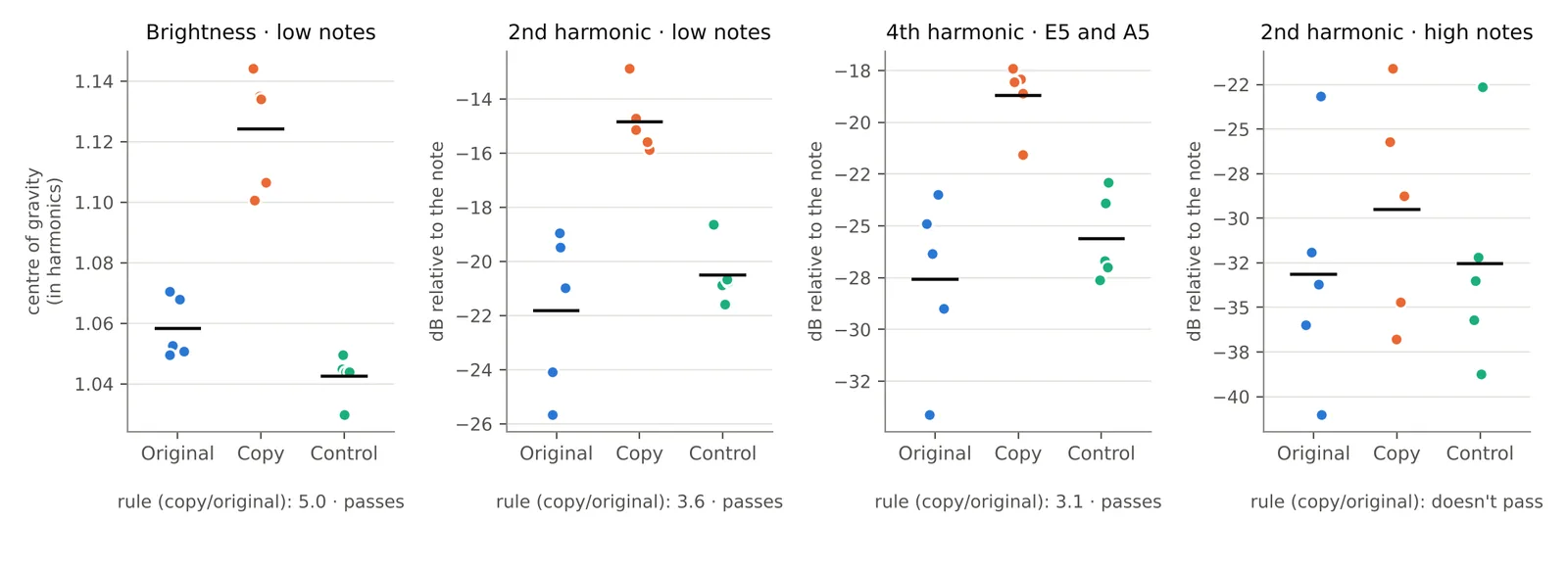
Table 4. Summary with the three-times rule (values of 3 or more pass the rule)
| What is measured | Original | Copy | Control | Copy vs original | Control vs original |
|---|---|---|---|---|---|
| Low notes (E5, G5, A5, B5) | |||||
| Brightness (centre of gravity of the sound) | 1.058 | 1.124 | 1.042 | 5.0 · passes | 1.2 · doesn’t pass |
| Share of the energy taken by the note | 95.1 % | 90.2 % | 96.7 % | 3.3 · passes | 1.1 · doesn’t pass |
| 2nd harmonic | −21.8 dB | −14.8 dB | −20.5 dB | 3.6 · passes | 0.7 · doesn’t pass |
| 3rd harmonic | −28.2 dB | −27.2 dB | −30.2 dB | 0.3 · doesn’t pass | 0.5 · doesn’t pass |
| 4th harmonic (E5 and A5) | −27.6 dB | −18.7 dB | −25.6 dB | 3.1 · passes | 0.7 · doesn’t pass |
| 5th harmonic (G5 and B5) | −36.8 dB | −34.9 dB | −42.8 dB | 0.5 · doesn’t pass | 1.6 · doesn’t pass |
| All 6 notes together | |||||
| Brightness | 1.041 | 1.093 | 1.030 | 3.5 · passes | 0.7 · doesn’t pass |
| Share of the energy taken by the note | 96.6 % | 93.0 % | 97.7 % | 2.8 · doesn’t pass | 0.8 · doesn’t pass |
| 2nd harmonic | −25.0 dB | −19.7 dB | −24.2 dB | 2.2 · doesn’t pass | 0.3 · doesn’t pass |
| High notes (D6, E6) | |||||
| Brightness | 1.008 | 1.032 | 1.006 | 0.8 · doesn’t pass | 0.0 · doesn’t pass |
| Share of the energy taken by the note | 99.6 % | 98.4 % | 99.6 % | 0.8 · doesn’t pass | 0.0 · doesn’t pass |
| 3rd harmonic | −26.5 dB | −24.5 dB | −28.5 dB | 0.5 · doesn’t pass | 0.5 · doesn’t pass |
| 2nd, 4th and 5th harmonics | — | — | — | doesn’t pass in any note | doesn’t pass in any note |
The values for each note are measured by our program. The averages for each flute, the groups of notes and the result of the rule are calculated by us from them. The result of the rule is the difference between the two flutes divided by how much the recordings of the same flute vary (the standard deviation of the 5 takes, pooled across the three flutes). Brightness is the centre of gravity of the energy of the note and its 2nd to 5th harmonics, counted in harmonics, and it equals 1 if only the note sounded. The note’s share of the energy is calculated against the sum of the note and its 2nd to 5th harmonics, with the breath noise already subtracted. The 4th and 5th are only compared in the notes where the program measured them in all 15 recordings. In the high notes, the 2nd, 4th and 5th couldn’t be measured in every recording, so they’re compared note by note (none passes).
Why did we separate the low notes from the high ones?
This needs to be told properly, because it wasn’t planned. We decided to split the four low notes and the two high ones after seeing the data. Looking at Figure 6, you could see that the copy moved far away from the original in E5, G5, A5 and B5, and only a little in D6 and E6. Splitting the groups after seeing the data carries a risk. If you choose the split that suits you best, you can make a difference look clearer than it is.
There are two reasons to think the high notes really do behave differently.
In the high notes, each flute changes much more from one recording to another. The 2nd harmonic varies by about 7 dB between takes of the same flute in D6 and E6, compared with 3 or 4 dB in the low notes. With so much variation, a small difference can’t be seen. It’s the scale that wobbles by a kilo.
In the high notes there are harmonics the program couldn’t measure, because they were below the breath noise. Data are missing precisely there.
Also, so as not to fool ourselves, we checked what happens if we group the notes in other ways.
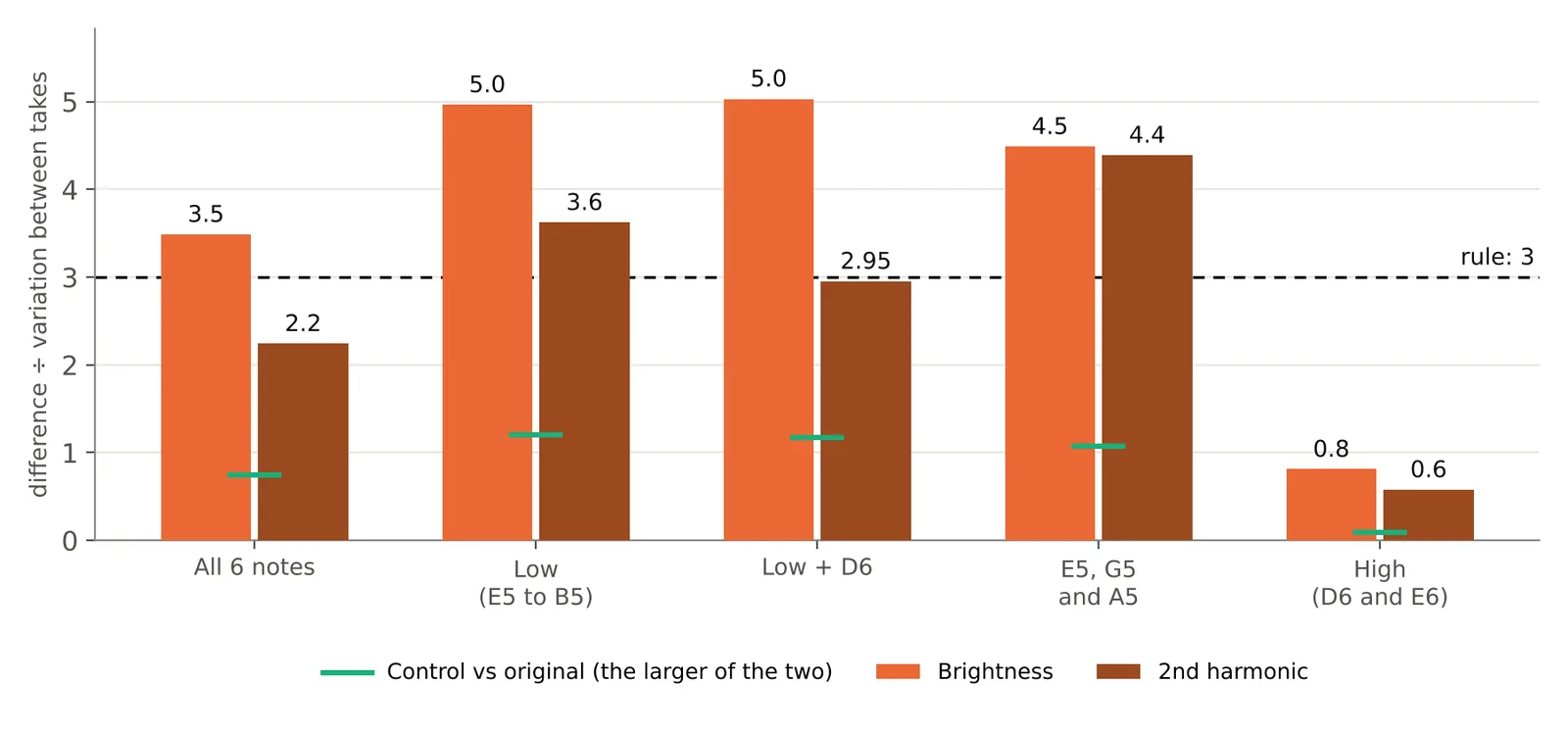
The copy’s brightness passes the rule in every grouping except the high notes alone, including all six notes together (3.5). It doesn’t depend on how we split them.
The 2nd harmonic passes in the low notes (3.6), and with more margin if we keep only E5, G5 and A5 (4.4). With all six notes together it doesn’t pass (2.2), and if we also add D6 to the low notes it sits right at the limit (2.95), without reaching it.
Between the two wooden flutes, no grouping passes (1.2 at most).
So the firm result is that the copy is brighter, and that doesn’t depend on how we group the notes. That this brightness comes mainly from the 2nd harmonic of the low notes can also be seen clearly, but it depends more on where we put the split, which is why we state it more cautiously.
What exactly the program does
With these concepts you can now understand what exactly the program measures. So that everything can be checked, I separate what the program measures from what we did afterwards with its data.
What the program measures, note by note. In each recording it finds each note of the scale and takes its spectrum (with a resolution of about 2.7 Hz). Then it looks for the note and its harmonics, from the 2nd to the 5th. For each one it adds up the energy right around its frequency and subtracts the breath noise, which it calculates in the gaps between the harmonics. Why subtract the breath noise? Because the hiss of the breath isn’t only between the harmonics; it also sounds at the same frequencies as them. When the program adds up the energy around a harmonic, part of that energy is breath noise, not harmonic. In strong harmonics, like the 2nd in the low notes, the breath noise hardly changes the result. In weak ones, like the 4th or the 5th, or in the high notes, the breath noise can be almost as much as the harmonic itself, and without subtracting it we’d measure them stronger than they are. Also, if one flute had more breath noise than another, its harmonics would seem stronger for that reason alone. As the breath noise is measured in the gaps between harmonics and subtracted, what’s left is the harmonic alone, and it can be compared between flutes.
With that, for each note it gives four kinds of data.
The level of each harmonic, from the 2nd to the 5th, in decibels below the note.
How much of the energy the note takes (explained in «A few concepts»).
Brightness (also in «A few concepts»).
Whether a harmonic could be measured or not. It only counts it as measured if, once the breath noise is subtracted, it has at least as much energy as the breath noise around it. If not, it leaves it without data. That’s why the 4th or 5th is missing in some notes.
What we calculated with that data. The averages for each flute, the groups of notes (low, high or all), the three-times rule and Figures 2, 4, 6, 12 and 13. When a recording is missing a harmonic, we average over the notes that do have data. The spectrum in Figure 5 doesn’t come from the program. We calculated it directly from the recordings, without subtracting the breath noise, so we could show it in full.
The recordings, the data for each note and the calculations are kept. If anyone wants to review them, they can write to us and we’ll send them over.
See the full data
For anyone who wants to check. Values measured by the program in the 5 recordings of each flute, note by note, relative to the note (0 dB). In brackets, in how many of the 5 recordings that harmonic could be measured. When it couldn’t, it’s because it was below the breath noise.
2nd harmonic (dB relative to the note): mean ± standard deviation (takes measured out of 5)
| Note | Original | Copy | Control |
|---|---|---|---|
| E5 | −9.0 ± 5.5 (5) | −4.7 ± 3.0 (5) | −11.6 ± 4.7 (5) |
| G5 | −22.2 ± 4.2 (5) | −12.9 ± 1.8 (5) | −19.2 ± 3.8 (5) |
| A5 | −26.0 ± 4.8 (5) | −19.9 ± 2.6 (5) | −22.8 ± 1.9 (5) |
| B5 | −30.2 ± 6.0 (5) | −21.8 ± 3.9 (5) | −28.4 ± 2.0 (5) |
| D6 | −33.7 ± 6.7 (5) | −30.1 ± 7.6 (5) | −34.7 ± 6.1 (4) |
| E6 | −30.1 ± 6.6 (3) | −28.9 ± 6.2 (5) | −30.6 ± 7.6 (5) |
3rd harmonic (dB relative to the note): mean ± standard deviation (takes measured out of 5)
| Note | Original | Copy | Control |
|---|---|---|---|
| E5 | −20.6 ± 6.7 (5) | −24.5 ± 5.9 (5) | −21.5 ± 1.9 (5) |
| G5 | −29.2 ± 4.8 (5) | −28.2 ± 3.6 (5) | −36.2 ± 8.3 (5) |
| A5 | −35.9 ± 6.3 (5) | −28.6 ± 2.4 (5) | −32.7 ± 7.2 (5) |
| B5 | −27.2 ± 3.9 (5) | −27.6 ± 4.3 (5) | −30.4 ± 5.1 (5) |
| D6 | −28.0 ± 2.2 (5) | −26.8 ± 5.0 (5) | −26.4 ± 3.3 (5) |
| E6 | −24.9 ± 3.6 (5) | −22.1 ± 8.2 (5) | −30.5 ± 1.8 (5) |
4th harmonic (dB relative to the note): mean ± standard deviation (takes measured out of 5)
| Note | Original | Copy | Control |
|---|---|---|---|
| E5 | −21.5 ± 2.5 (5) | −14.1 ± 3.6 (5) | −19.7 ± 3.7 (5) |
| G5 | no data (0) | −36.6 ± 6.2 (4) | −41.6 ± 2.6 (3) |
| A5 | −33.6 ± 7.4 (5) | −23.3 ± 3.6 (5) | −31.6 ± 3.6 (5) |
| B5 | −41.5 ± 1.3 (3) | −39.3 ± 4.3 (5) | −46.7 ± 1.4 (3) |
| D6 | −46.5 ± 5.4 (2) | −47.0 ± 2.3 (4) | −44.9 ± 3.1 (2) |
| E6 | −39.9 ± 6.1 (4) | −33.9 ± 7.8 (3) | −31.0 (1) |
5th harmonic (dB relative to the note): mean ± standard deviation (takes measured out of 5)
| Note | Original | Copy | Control |
|---|---|---|---|
| E5 | −37.9 ± 7.1 (3) | −28.6 ± 2.3 (5) | −41.3 ± 3.0 (3) |
| G5 | −37.3 ± 2.1 (5) | −36.5 ± 2.9 (5) | −42.7 ± 3.8 (5) |
| A5 | −38.0 ± 2.5 (4) | −39.6 ± 3.9 (5) | −43.5 ± 1.8 (4) |
| B5 | −36.3 ± 4.8 (5) | −33.2 ± 9.5 (5) | −42.9 ± 5.6 (5) |
| D6 | −50.9 ± 3.2 (4) | −46.9 ± 7.3 (4) | −49.4 ± 2.5 (2) |
| E6 | −35.8 ± 1.4 (4) | −36.1 ± 13.2 (3) | no data (0) |
Sources
Backus, J. (1964). Effect of wall material on the steady-state tone quality of woodwind instruments. Journal of the Acoustical Society of America, 36. Summarised by Bret Pimentel.
Coltman, J. W. (1971). Effect of material on flute tone quality. Journal of the Acoustical Society of America, 49, 520–523. Article (PDF).
Fletcher, N. H. and Douglas, L. M. (1980). Harmonic generation in organ pipes, recorders, and flutes. Journal of the Acoustical Society of America, 68. Abstract.
Linortner, R. (2001). Silber, Gold, Platin… Der Materialaspekt bei Querflöten. Institut für Wiener Klangstil, University of Music and Performing Arts Vienna. Study page.
Fritz, C., Jossic, M., Bastien, C., Chang, L., Jang, M., Vaiedelich, S. and Lambert, E. (2025). 3D Printing in the Museum: Perceptual Discrimination between a Hotteterre Traverso Facsimile and its Printed Copies. Music & Science, 8. Article.
Niu, X. (2019). PLA-printed ukulele compared with a wooden one. News on TechXplore.
Review on replicas of historical instruments and materials (2026). arXiv (PDF).
WIDesigner, by Edward Kort. Free wind instrument design program.
Our own measurements. Recordings from 26-10-2026 (Zoom H4n Pro at 30 cm, 5 recordings per flute), analysed with our program in a testing phase, and caliper measurements from 2-11-2026. Data and calculations available on request.
